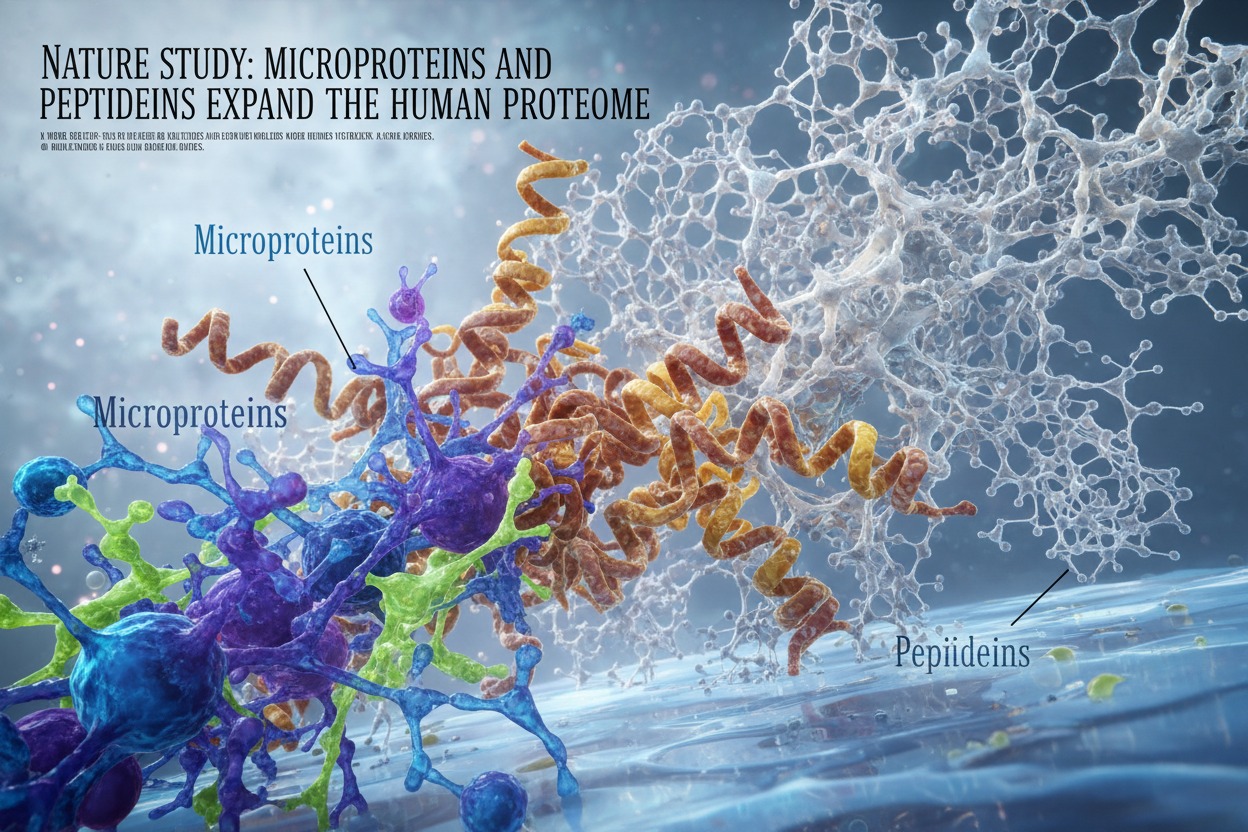
Rethinking the Boundaries of the Human Proteome
The human proteome has traditionally been defined as the complete set of proteins encoded by our genes. For decades, scientists believed they had a relatively clear map of this landscape, focusing primarily on large, well-characterized proteins translated from clearly defined genes. However, recent research highlighted in Nature Study: Microproteins and Peptideins Expand the Human Proteome is reshaping that view.
The study reveals that a vast and previously underappreciated class of molecules—microproteins and peptideins—is significantly expanding our understanding of human biology. These small yet powerful biological players are challenging long-held assumptions about what constitutes a functional protein and how genetic information is utilized within our cells.
What Are Microproteins and Peptideins?
Microproteins are short proteins typically composed of fewer than 100 amino acids. For years, they were overlooked because traditional gene annotation pipelines focused on longer stretches of DNA encoding larger proteins. Similarly, peptideins represent small peptides that may be translated from regions previously classified as non-coding RNA or overlooked small open reading frames (sORFs).
What distinguishes these molecules is not just their size but their functional importance. Once dismissed as genomic noise, they are now recognized as biologically active elements with regulatory and structural roles.
Key Characteristics of Microproteins
- Usually fewer than 100 amino acids in length
- Encoded by small open reading frames (sORFs)
- Often derived from regions previously labeled non-coding
- Functionally active in cellular signaling, metabolism, and gene regulation
The growing body of evidence suggests that these molecules are not rare anomalies but abundant components of the proteome, woven intricately into fundamental biological processes.
The Discovery Challenge: Why Were They Missed?
One of the most compelling aspects of this research is how it exposes the limitations of earlier scientific methodologies. Traditional protein detection techniques and computational gene prediction tools were optimized to detect long, canonical protein-coding sequences. Small open reading frames were often filtered out to avoid false positives.
This conservative approach led to systemic underreporting of functional microproteins. Advances in high-resolution mass spectrometry, ribosome profiling, and refined bioinformatics pipelines have now uncovered thousands of previously undetected peptides actively translated within human cells.
Technological innovation has been instrumental in bringing these hidden components of the proteome into focus.
Expanding the Functional Landscape of Human Biology
The identification of microproteins and peptideins significantly alters our understanding of cellular complexity. Rather than being limited to a defined set of large proteins, cells appear to operate through a dynamic and multilayered network of both large and small molecular components.
These newly recognized molecules are implicated in:
- Regulation of gene expression
- Cellular stress response
- Signal transduction pathways
- Mitochondrial function
- Developmental processes
Some microproteins act as modulators, binding to larger proteins and altering their activity. Others influence transcriptional regulation or play structural roles within organelles. Their small size often enables rapid synthesis and degradation, making them highly adaptable tools for fine-tuning cellular responses.
Microproteins as Regulatory Switches
One emerging theme is the role of microproteins as molecular switches. By interacting directly with larger protein complexes, they can enhance or suppress dominant cellular pathways. This fine regulatory control suggests that cells use microproteins as precise instruments rather than relying solely on broad-scale protein signaling.
This discovery reframes the proteome as not simply a collection of structural components but as a highly coordinated regulatory system with previously invisible layers.
Implications for Human Health and Disease
Perhaps the most transformative aspect of the study lies in its medical implications. If microproteins and peptideins are functional and widespread, their dysregulation may contribute to disease.
Early evidence suggests links between small peptides and conditions such as:
- Cancer progression
- Metabolic disorders
- Cardiovascular disease
- Neurodegenerative conditions
In oncology, for example, certain microproteins appear to influence tumor growth by modulating key signaling pathways. Because they were previously unrecognized, these molecules may represent untapped therapeutic targets.
The possibility of targeting microproteins opens a new frontier in precision medicine. Smaller peptides may be easier to manipulate pharmacologically, and their compact structure could allow for more targeted therapeutic interventions with fewer systemic effects.
Diagnostic Potential
Beyond treatment, microproteins may serve as novel biomarkers. Their expression patterns could provide early indicators of disease states. As proteomic technologies improve, researchers may be able to detect subtle shifts in these small molecules long before larger protein changes become apparent.
This diagnostic potential underscores the importance of fully mapping the expanded human proteome.
Redefining ‘Non-Coding’ DNA
One of the broader scientific impacts of this research is its challenge to the traditional binary divide between coding and non-coding regions of the genome. Sections once labeled non-functional or merely regulatory may in fact encode biologically active peptides.
This paradigm shift aligns with emerging evidence that the genome is far more versatile than previously believed. Instead of discrete categories, genetic material may operate along a continuum, with hidden layers of functionality embedded within so-called non-coding sequences.
The boundaries of gene annotation are being redrawn. What was once considered genomic dark matter is increasingly illuminated as a source of translational potential.
Technological Advances Driving Discovery
The rapid acceleration in identifying microproteins is tied directly to technological breakthroughs. Key innovations include:
- Ribosome profiling to track active translation events
- High-resolution mass spectrometry to detect low-abundance peptides
- Advanced computational models to reanalyze genomic data
- CRISPR-based validation tools to confirm functional relevance
These tools enable researchers not only to detect small proteins but also to verify their roles in living systems. Integrated multi-omics approaches are particularly powerful, combining transcriptomic, proteomic, and epigenetic data to construct a more comprehensive proteome map.
The Evolutionary Perspective
From an evolutionary standpoint, microproteins may offer adaptive advantages. Their small size allows rapid gene evolution, enabling organisms to experiment with new functional molecules without extensive genomic restructuring.
Such flexibility could explain the diversity and ubiquity of microproteins across species. They may represent evolutionary testing grounds where new biological functions emerge.
This perspective positions microproteins not as peripheral components but as drivers of biological innovation.
Future Research Directions
The field is still in its early stages, and many questions remain unanswered:
- How many microproteins exist in the human body?
- What proportion have distinct biological functions?
- How do small peptides integrate with larger protein networks?
- Can they be systematically targeted in therapeutic contexts?
Future research will likely focus on constructing comprehensive catalogs of small open reading frames and validating their translational output. Functional assays will also be critical in determining which peptides are essential and which may serve context-dependent roles.
As large-scale initiatives integrate proteomic data across tissues and developmental stages, the expanded proteome will become clearer.
A New Era for Proteomics
The recognition of microproteins and peptideins marks a turning point in molecular biology. Instead of viewing the proteome as a static, cataloged entity, scientists now understand it as a dynamic and layered system with hidden complexity.
This shift has profound implications for:
- Genomic annotation standards
- Drug discovery strategies
- Disease diagnostics
- Evolutionary biology research
By expanding the known boundaries of protein-coding potential, researchers are opening doors to discoveries that may reshape therapies, redefine genetic interpretation, and deepen our understanding of cellular machinery.
In illuminating the subtle yet significant roles of microproteins and peptideins, this research underscores a broader scientific lesson: even the smallest biological components can have outsized impacts. The human proteome, once thought to be largely mapped, is now revealed to be richer, more intricate, and more dynamic than previously imagined.