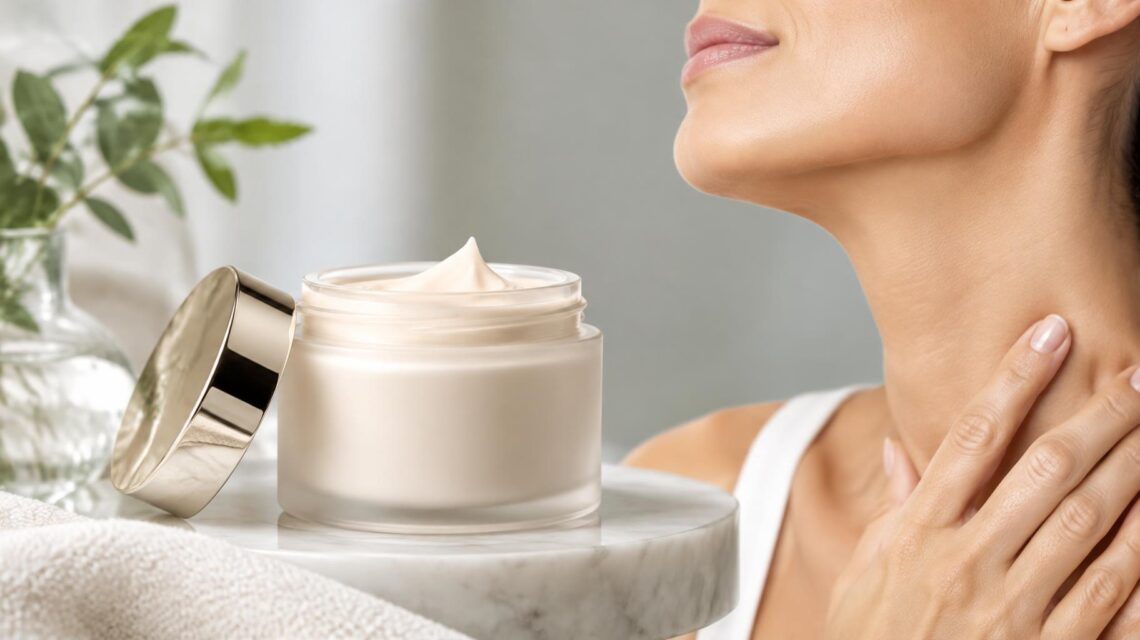
Trinny London The Elevator neck cream promises a more targeted approach to caring for the neck and décolleté. But beyond the lifting language and polished packaging, what does the formula actually contain, and how much can those ingredients tell you about its potential?
The most useful starting point is to separate recognisable cosmetic ingredients from claims about the finished product. The Elevator contains several genuine peptides, alongside alpha arbutin and a botanical ingredient listed as Isodonis japonicus. Those are different types of ingredients, and they should not all be grouped together as a peptide complex.
Here is a closer look at what is in The Elevator, what the available evidence establishes, and what to consider before buying.
What Is Trinny London The Elevator?
The Elevator is a neck and décolleté concentrate from Trinny London. Although it is often searched for as a neck cream, the concentrate description reflects its positioning as a targeted skincare product rather than simply a general moisturiser.
Liberty lists a 50ml refill at £69. That is a specific format and listing price, rather than a guarantee of what every retailer or packaging option will cost. Check the current listing and whether you are purchasing a refill or a complete pack before comparing prices.
It is also worth correcting the timeline: The Elevator is not a new 2026 launch. Coverage from Woman & Home establishes that the product was already available by 8 May 2024. Renewed attention should not be confused with a newly developed formula or newly published evidence.
What Is Actually in The Elevator Neck Cream?
The ingredient details supplied by Liberty identify four peptides, alpha arbutin and Isodonis japonicus. This is a useful breakdown of those ingredients, not a complete ingredient list. For the full formula, consult the current packaging or retailer information.
Decapeptide-22
Decapeptide-22 is a genuine peptide ingredient. Peptides are made from linked amino acids and appear in cosmetic formulas for a range of purposes.
However, identifying a peptide does not establish how much of it is present, how it behaves within a particular formula, or whether the finished product produces a meaningful visible change. The ingredient name is a starting point for understanding the product, not proof of a lifting effect.
Oligopeptide-78
Oligopeptide-78 is another actual peptide in The Elevator. Its inclusion helps explain why the formula is discussed as peptide-containing skincare.
The important distinction is between an ingredient having a technical identity and a product having demonstrated results. The name alone does not reveal its concentration, delivery or contribution to the overall performance of the concentrate.
Palmitoyl sh-Octapeptide-8
Palmitoyl sh-Octapeptide-8 also belongs in the peptide category. The palmitoyl portion indicates a fatty-acid modification to the peptide structure.
That chemistry may sound impressive, but a technical name cannot tell a shopper whether a product will visibly firm their neck. What matters is evidence relevant to the complete formulation, not simply how sophisticated an individual ingredient sounds.
Zinc Palmitoyl Nonapeptide-14
Zinc Palmitoyl Nonapeptide-14 is the fourth genuine peptide identified in the supplied ingredient information.
Its presence supports describing The Elevator as a formula containing multiple peptides. It does not, by itself, support claims that the product reverses sagging, rebuilds collagen or recreates a cosmetic procedure. Those are separate claims requiring appropriate evidence.
Alpha Arbutin
Alpha arbutin is a small molecule, not a peptide. This distinction matters when assessing descriptions of the formula: an ingredient can have a role in skincare without belonging to the peptide family.
Alpha arbutin is commonly discussed in cosmetics in relation to uneven-looking pigmentation. However, the supplied references do not establish its concentration in The Elevator or demonstrate a specific pigmentation outcome from this finished product. Its inclusion should not be presented as a guaranteed result.
Isodonis Japonicus
Isodonis japonicus is a botanical ingredient, rather than a peptide. Plant-derived ingredients can be part of a carefully formulated cosmetic product, but botanical origin is not evidence of superior performance.
The supplied references do not establish a specific visible benefit attributable to this ingredient in The Elevator. It is more accurate to identify it as part of the formula than to assign it an unverified lifting or collagen-related effect.
Why a Peptide List Is Not the Same as Product Proof
A formula containing four peptides can sound more compelling than one containing a single peptide. Yet ingredient count is not a reliable performance ranking.
To interpret a skincare formula properly, several details matter:
- Concentration: the presence of an ingredient does not disclose how much is used.
- Formulation: ingredients function within a complete product, not in isolation.
- Stability: the finished formula needs to maintain its intended characteristics.
- Testing: product-specific evidence is more informative than broad ingredient claims.
The available information does not establish that these four peptides deliver an additive or superior effect together. Equally, that does not prove the formula is ineffective. It means the ingredient list alone cannot settle the question.
What Does the Eight-Week Trial Actually Tell Us?
The supplied coverage describes a brand eight-week dermatological trial with before-and-after images. That is relevant, but the reporting does not publish a participant number or enough methodological detail to evaluate the findings independently.
Without those details, readers cannot properly assess how participants were selected, whether there was a comparison group, how outcomes were measured or how consistently photographs were taken.
Before-and-after images can illustrate a reported change, but lighting, posture, camera angle and skin hydration can influence appearance. A persuasive photograph is not equivalent to a controlled, independently assessable result.
The appropriate conclusion is therefore limited: the brand has presented trial-based material, but the supplied references do not establish peer-reviewed proof of a lifting or collagen-boosting effect.
Can The Elevator Replace a Facelift?
No evidence in the supplied sources supports describing The Elevator as a replacement for a facelift. Phrases suggesting that a cream resists gravity or produces surgical-style lifting should be treated as marketing, not established clinical findings.
A cosmetic product improving how skin looks or feels is a different proposition from changing the underlying structures involved in neck sagging. Those outcomes should not be blurred together.
Similarly, the presence of peptides is not sufficient evidence that this particular formula increases collagen in users. A collagen-related claim needs suitable product-specific support.
What to Check Before Buying
If you are considering Trinny London The Elevator neck cream, focus on practical information rather than the strongest promotional wording.
- Read the complete ingredient list: the highlighted ingredients are only part of the formula.
- Confirm the format: Liberty lists a 50ml refill, so check what your purchase includes.
- Review the current price: the supplied £69 figure relates to that retailer listing.
- Assess the evidence: look for published methods and clear outcome measures, not photographs alone.
- Keep expectations realistic: evaluate it as cosmetic skincare, not a non-surgical procedure.
The Bottom Line on The Elevator Ingredients
Trinny London The Elevator contains four identifiable peptides: Decapeptide-22, Oligopeptide-78, Palmitoyl sh-Octapeptide-8 and Zinc Palmitoyl Nonapeptide-14. Alpha arbutin is a separate small-molecule ingredient, while Isodonis japonicus is botanical.
That makes the formula more specific than vague peptide marketing might suggest. However, ingredient credibility is not the same as proven product performance. The available trial reporting lacks the detail needed to substantiate surgical-style lifting, gravity-defying or collagen-boosting claims. Judge The Elevator as a targeted cosmetic concentrate, with expectations grounded in the evidence available.
Sources