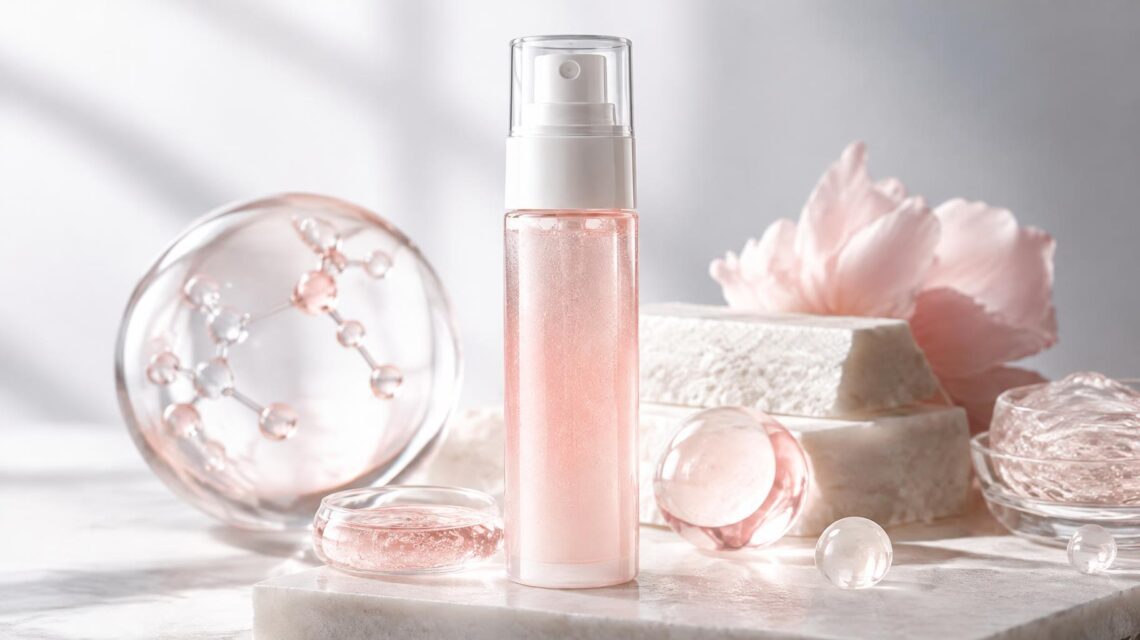
BIODANCE Collagen Peptide Jelly Serum Mist combines the convenience of a facial mist with the ingredient-led appeal of a serum. Its formula features collagen water and ten peptides, making it an interesting option for anyone comparing Korean skincare mists. But an impressive ingredient count is not the same as evidence of impressive performance.
The important question is what those ingredients tell us about the finished product. Although the peptides appear late in the ingredient list, their exact concentrations are not disclosed in the supplied references. That distinction matters: low placement warrants scrutiny, but it does not establish that every peptide is present only at a trace level.
Understanding the BIODANCE Collagen Peptide Jelly Serum Mist Formula
This product is presented as a jelly serum mist, a format that sits between a conventional facial spray and a leave-on serum. The appeal is straightforward: a sprayable skincare product offers convenience without requiring a separate dropper or pump application.
However, the words jelly, serum and mist describe positioning and format rather than proven effectiveness. They do not establish how deeply ingredients penetrate, how much peptide reaches the skin, or whether the formula produces lasting changes.
For a useful assessment, separate three things: what the ingredient list confirms, what the concentration declarations actually mean, and what remains unproven.
Ten Peptides: A Formula Feature, Not a Potency Score
The supplied ingredient information lists ten peptides. Examples include:
- Acetyl hexapeptide-8
- Copper tripeptide-1
- Palmitoyl pentapeptide-4
- Tripeptide-38
These names help explain why the product attracts attention from shoppers interested in peptide skincare. Nevertheless, counting peptides does not measure the strength of a finished formula. Ten different peptides do not automatically outperform one peptide in another product.
Concentration, ingredient stability, the formulation environment and evidence for the finished product all matter. An ingredient list alone cannot answer those questions. It confirms inclusion, not the magnitude of any cosmetic effect.
Does Their Position Prove They Are All at Trace Levels?
According to the supplied reference information, all ten peptides appear after sucrose and dextrin. This places them toward the lower end of the listed formula and gives shoppers a reasonable basis for questioning how much emphasis the peptide count deserves.
However, ingredient order cannot establish an exact concentration. Cosmetic labelling rules can permit ingredients below certain concentration thresholds to appear in a different order. Nor do sucrose and dextrin provide a known concentration benchmark simply because they appear before the peptides.
Consequently, the categorical claim that all ten peptides are at trace levels goes beyond what this placement alone demonstrates. The more defensible conclusion is that their individual amounts are undisclosed, their low placement calls for proportionate expectations, and the ten-peptide headline should not be treated as proof of potency.
Collagen Water Versus Collagen Extract: The Numbers Explained
The supplied product information declares collagen water at 770,965 ppm and collagen extract at 0.1 ppm. These figures look dramatically different because they describe separately named ingredients.
Here, ppm means parts per million. Expressed mathematically, 770,965 ppm corresponds to approximately 77.1%, while 0.1 ppm corresponds to 0.00001%. Those conversions are useful only when the identity of the measured material remains clear.
Collagen Water Is Not Necessarily Pure Collagen
A declaration of approximately 77.1% collagen water does not establish that approximately 77.1% of the bottle is pure collagen. Collagen water is an ingredient designation, and its stated amount should not be confused with the concentration of collagen protein within that material.
Without a fuller specification for the collagen-water ingredient, the headline figure cannot establish the total amount of collagen protein in the finished mist.
What the 0.1 ppm Figure Does Establish
The separately declared collagen extract amount of 0.1 ppm is very small. It is fair to describe that particular declaration as a trace quantity.
It is not, however, a complete measurement of every collagen-related component in the formula. Equally, the larger collagen-water number should not be used to obscure the much smaller extract declaration. Reading both together offers a more balanced picture than highlighting either figure in isolation.
Does Topical Collagen Replenish Skin Collagen?
Topical collagen does not replenish dermal collagen. Applying a collagen-containing cosmetic is not equivalent to replacing the collagen that provides structural support deeper within the skin.
This distinction is especially important when interpreting products whose names prominently feature collagen. The presence of the word on a label does not demonstrate that the product rebuilds skin structure.
Collagen-containing cosmetics can still be assessed for ordinary cosmetic qualities, such as their texture, finish and how the skin feels after application. Those considerations are different from claims about replacing collagen or reversing structural ageing. The supplied references do not establish such outcomes for this mist.
What the Product Listings and Reviews Tell You
The supplied Sephora UK listing information identifies a 50 ml size, priced at £11.99, with a rating of 4.37 out of 5 from 128 reviews, checked on 19 October 2026. Prices, availability and review totals can change.
That rating provides a snapshot of customer sentiment, not clinical evidence. A positive review may reflect enjoyment of the packaging, application experience or finish. It cannot establish peptide delivery, collagen replenishment or a specific biological mechanism.
The Peaches and Creme product listing is another reference point for checking the product information. When comparing listings, distinguish manufacturer declarations from retailer descriptions and customer impressions.
How to Judge Whether This Mist Offers Value
The most useful purchasing framework is practical rather than ingredient-count driven. Consider what you expect from a facial mist and whether the available information supports that expectation.
- Format: Is a sprayable serum more appealing to you than a conventional serum?
- Transparency: Are the quantities disclosed for the ingredients that matter most to you?
- Evidence: Are claims supported by finished-product testing, rather than ingredient names alone?
- Cost: Does the current price make sense for a 50 ml cosmetic mist?
- Expectations: Are you evaluating a cosmetic experience rather than expecting dermal collagen replacement?
The supplied references do not provide enough detail to establish the individual peptide concentrations or demonstrate a clinically meaningful advantage from combining ten peptides. That absence does not prove the product performs poorly. It simply limits what can responsibly be concluded.
Final Verdict: Look Beyond the Peptide Count
BIODANCE Collagen Peptide Jelly Serum Mist has an attention-grabbing formula story: ten peptides, a substantial collagen-water declaration and a convenient spray format. Those features may make it worth considering as a cosmetic mist, but they should not be mistaken for demonstrated potency.
The strongest criticism is a transparency gap, not a proven absence of value. The peptides appear late in the ingredient list, yet their exact amounts remain unknown. The collagen extract is declared at a trace quantity, while the much larger collagen-water figure does not represent an equivalent quantity of pure collagen.
Ultimately, judge this product by its disclosed formula, cosmetic experience and current price—not by the assumption that more peptide names mean better results. That approach keeps both the marketing and the criticism in proportion.