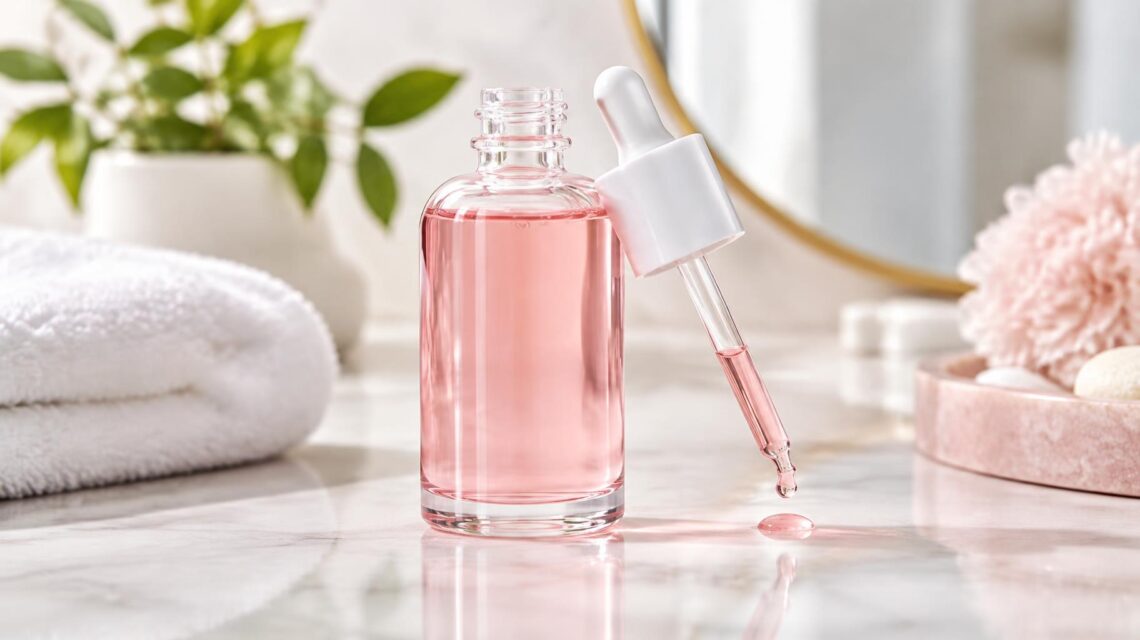
Searching for Medicube PDRN Pink Peptide Serum reviews can leave you with more questions than answers. Is PDRN a peptide? Does the pink formula contain salmon-derived ingredients? And how much weight should you give the promise of visible results in two weeks?
The clearest starting point is the ingredient label, not the product name. Medicube markets this serum around PDRN, peptides and collagen, but those ingredients belong to different categories. There are also salmon-derived and vegan rose-labelled versions to distinguish. This review examines the supplied product information rather than claiming hands-on testing or independently verified results.
What the Medicube PDRN Pink Peptide Serum Label Shows
The Medicube US product page lists a 30ml serum at USD24, with Salmon DNA PDRN and vegan Rose PDRN variants. The supplied Skinsider UK listing gives a price of GBP22.50. These are listed prices, not guarantees of current checkout pricing or availability.
The referenced ingredient information includes Sodium DNA, niacinamide, atelocollagen, hydrolyzed collagen and several peptides. However, shoppers should check the complete ingredient list for the specific variant they intend to purchase. A shared product name does not establish that two versions have identical formulas.
PDRN Is Not a Peptide
The most important distinction is also the easiest to miss: PDRN is not a peptide. PDRN refers to DNA-derived material made up of nucleotide fragments. Peptides, by contrast, consist of amino acids. Combining both terms in a serum name does not make them interchangeable.
The supplied UK listing identifies the salmon PDRN ingredient as Sodium DNA. That ingredient should be evaluated separately from the actual peptides in the formula.
Why this matters when reading reviews
A review that describes PDRN as the main peptide is misreading the ingredient category. Likewise, research involving a different PDRN preparation or delivery method cannot automatically establish what this finished cosmetic serum does.
For a useful assessment, keep three questions separate: what the ingredient is, what evidence exists for that ingredient, and what evidence exists for this particular product. A detailed ingredient list answers the first question more readily than the last.
Which Ingredients Deserve a Closer Look?
The formula brings together several ingredient categories. Their presence helps explain the product positioning, but it does not reveal the concentration, stability or performance of every component.
Sodium DNA
Sodium DNA is the label term associated with salmon-derived PDRN in the supplied listing. Its presence confirms an ingredient identity, not a particular cosmetic outcome. The label alone cannot establish how noticeable any effect would be or how this serum compares with other PDRN products.
Niacinamide
Niacinamide is another listed ingredient worth noting. However, the supplied reference material does not establish its concentration. Reviews should therefore avoid treating this serum as equivalent to a dedicated niacinamide product with a disclosed percentage.
Atelocollagen and hydrolyzed collagen
The ingredient information includes atelocollagen and hydrolyzed collagen. Collagen is a protein, while hydrolyzed collagen is protein broken into smaller fragments. These ingredients should not be confused with PDRN or presented as proof that the serum rebuilds collagen within skin.
The actual peptides
The referenced formula includes acetyl hexapeptide-8, copper tripeptide-1 and palmitoyl peptides. These are the ingredients that support describing the product as a peptide-containing serum.
Still, the presence of several peptides does not demonstrate that the finished formula outperforms a simpler alternative. Without disclosed concentrations and suitable product testing, counting peptide names is not a reliable way to rank effectiveness.
Salmon DNA PDRN vs Vegan Rose PDRN
Medicube lists two variants: Salmon DNA PDRN and vegan Rose PDRN. This distinction matters for shoppers with ingredient-source preferences, especially those avoiding animal-derived skincare.
Do not assume that every pink Medicube serum is vegan. The salmon-derived option and the vegan-labelled rose option should be treated as distinct choices. Check the selected variant, packaging and full ingredient list rather than relying on the product photograph.
The supplied references do not establish that the two versions have identical performance. They also do not provide enough comparative evidence to declare one better. Ingredient origin and demonstrated cosmetic performance are separate considerations.
What Does the Two-Week Results Claim Mean?
The brand page claims visible results in two weeks. That is a brand claim, not published trial data in the supplied references. No published finished-product study is provided here that would allow readers to examine the methods or independently assess the result.
A meaningful evaluation would require more information, including:
- What visible results were measured.
- How many people participated.
- Whether there was a comparison group.
- Whether outcomes were assessed objectively or self-reported.
- Which variant was tested.
Without those details, the two-week statement should not become a guaranteed timeline in a review. It also should not be rewritten as clinically proven improvement.
Dermatologist Testing and MFDS Claims: Read Them Carefully
The supplied brand information describes the serum as dermatologist-tested and references Korean MFDS dual-function status. These statements need context rather than expansion into broader promises.
Dermatologist-tested does not mean universally suitable, and the phrase alone does not disclose the testing protocol. Similarly, a Korean functional-cosmetic designation should not be presented as proof of every marketing claim or as approval to treat a medical condition.
This article concerns a topical cosmetic serum. It should not be confused with injectable PDRN products or research preparations, whose evidence, regulatory status and intended uses require separate assessment.
How to Judge Medicube PDRN Pink Peptide Serum Reviews
The supplied sources are product listings, not a verified collection of customer reviews. They do not establish a customer satisfaction rate, an average rating or a reliable consensus about texture and wear. Claims that everyone finds it lightweight, non-sticky or suitable under makeup would therefore go beyond the available information.
When comparing genuine user reviews, look for details that make an experience easier to interpret:
- Exact variant: Was it Salmon DNA PDRN or vegan Rose PDRN?
- Skin context: Does the reviewer explain their usual preferences and concerns?
- Other products: Was the serum introduced alongside several new items?
- Specific observations: Are comments about application separated from longer-term appearance claims?
- Commercial disclosure: Was the product purchased, gifted or featured in sponsored content?
Before-and-after photographs also deserve caution. Different lighting, camera settings and makeup can affect how skin appears. A personal review can describe an experience without proving that the serum caused every visible change.
Is Medicube PDRN Pink Peptide Serum Worth Considering?
On paper, this is a multi-ingredient cosmetic serum combining DNA-derived material, niacinamide, collagen ingredients and genuine peptides. Its clearest shopping considerations are variant selection, ingredient-source preferences, listed price and evidence quality.
The label supports describing it as a PDRN-and-peptide serum. It does not support treating PDRN as a peptide, promising results within two weeks or claiming equivalence with professional procedures.
The balanced takeaway from Medicube PDRN Pink Peptide Serum reviews is to distinguish an appealing formula from demonstrated performance. Check the exact version, read the complete label and treat marketing timelines as claims—not guarantees.