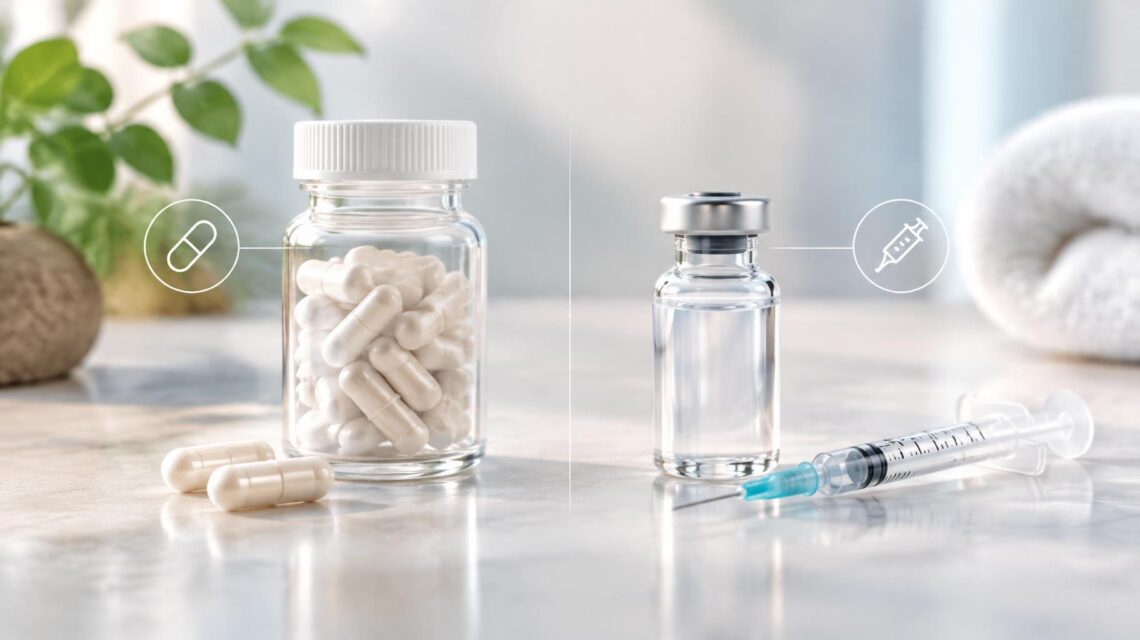
The debate over BPC-157 oral vs injection often starts with a simple assumption: if a peptide survives the stomach, an oral product should work; if it is injected, it should reach the body more effectively. Neither conclusion follows automatically from the available evidence.
BPC-157 is an experimental compound, and most of its published efficacy research involves rodents. Laboratory stability findings and animal pharmacokinetic studies cannot establish how an oral or injectable product performs in humans. Understanding that distinction is essential to interpreting the science without turning preliminary findings into treatment claims.
Stability Is Not the Same as Bioavailability
BPC-157 is a synthetic pentadecapeptide, meaning it contains 15 amino acids. A 2025 review in Pharmaceuticals describes a molecular weight of 1419.55 and summarizes research into its biological activity and pharmacokinetics.
For any peptide, several separate questions determine what happens after administration:
- Stability: Does the molecule remain chemically intact under particular conditions?
- Absorption: Does it cross biological barriers?
- Bioavailability: How much reaches systemic circulation intact?
- Distribution: Where does it travel after entering circulation?
- Clinical efficacy: Does it produce a meaningful benefit in people?
A finding about one step does not answer the others. In particular, surviving an acidic environment does not demonstrate intestinal absorption, and measurable blood concentrations do not prove clinical benefit.
What BPC-157 Stability Research Can Show
Peptides can face several obstacles in the digestive tract, including acidic conditions, digestive enzymes and the intestinal barrier. Research discussing BPC-157 frequently emphasizes its reported stability in gastric conditions. This is scientifically relevant, but its meaning depends on the experimental setup.
Gastric Stability Is a Limited Finding
A laboratory experiment can investigate whether a peptide remains intact in a particular medium over a defined observation period. That can help researchers characterize the molecule. It does not reproduce every condition encountered in a living human digestive system.
Even if a peptide remains intact in the stomach, it must still navigate the rest of the gastrointestinal tract. Stability does not establish how much crosses the intestinal lining, how much is metabolized before reaching circulation, or whether exposure is consistent between individuals.
The key distinction is that gastric stability may support further investigation, but it is not a substitute for human oral bioavailability data.
Stability Also Depends on the Formulation
Evidence about a peptide molecule should not automatically be applied to every finished product containing that name. Formulation, storage conditions and manufacturing quality can affect the integrity of peptide preparations.
Consequently, a general statement that BPC-157 is stable cannot establish the shelf life, purity or performance of an individual product. Those questions require product-specific analytical evidence.
BPC-157 Oral: What Remains Unknown
For readers comparing oral BPC-157 with injections, the central evidence gap is straightforward: no established human oral bioavailability figure is available in the supplied research.
Without that information, it is not possible to give a reliable percentage for how much orally administered BPC-157 reaches human systemic circulation. Claims of high absorption, predictable exposure or equivalence to an injectable preparation go beyond what the cited evidence supports.
Local Exposure and Systemic Exposure Are Different
Research involving the gastrointestinal tract can raise questions about local biological activity. However, possible local exposure is not the same as demonstrated systemic delivery.
Likewise, an observation in an animal digestive system cannot establish that an oral product produces a particular outcome in people. The site of exposure, the species studied and the measured endpoint all matter when interpreting a result.
BPC-157 Injection: What Animal Pharmacokinetics Show
Injection is sometimes described as if it automatically resolves the uncertainties surrounding BPC-157. Although it avoids some gastrointestinal barriers, it does not establish human effectiveness, predictable tissue exposure or safety.
The pharmacokinetic findings summarized in the 2025 review are animal data, not human data. Reported intramuscular bioavailability was approximately 14–19% in rats and 45–51% in dogs. The review also describes a half-life of under 30 minutes in animal pharmacokinetic research.
These findings illustrate why broad claims about injectable absorption are unreliable. Even within animal research, measured exposure differed substantially between species.
Animal Percentages Cannot Be Applied to Humans
Species differ in metabolism, enzyme activity, circulation and other biological characteristics. A bioavailability percentage measured in a rat or dog therefore cannot be treated as an expected human value.
Similarly, a short measured half-life describes the disappearance of the measured compound under the study conditions. It does not independently establish the duration of any biological effect or support assumptions about human use.
Does the Evidence Favor Oral BPC-157 or Injection?
The available evidence does not establish a clinically superior option for humans. A meaningful comparison would require reliable human studies using characterized formulations, validated measurements and relevant clinical outcomes.
The evidence summarized here does not provide that foundation. Instead, it offers different kinds of preliminary information:
- Stability research examines whether the molecule remains intact under specified conditions.
- Animal pharmacokinetics describes exposure and elimination in the species studied.
- Preclinical efficacy research investigates biological effects, overwhelmingly in rodents.
- Human clinical evidence remains insufficient to establish efficacy or a dependable oral-versus-injection comparison.
Combining these categories into a claim that one formulation works better skips several necessary steps in clinical research.
Human Evidence, FDA Status and Safety
The 2025 review reports no completed clinical studies describing BPC-157 efficacy in humans. It also notes that results associated with the phase I registration NCT02637284 were withdrawn in 2016. A trial registration alone is not evidence of a successful clinical outcome.
BPC-157 is not FDA-approved. Its experimental status should remain central to any discussion of oral or injectable products.
The FDA identifies potential safety concerns involving BPC-157 in its information on bulk substances nominated for compounding, including immunogenicity concerns for certain routes. Immunogenicity refers to the potential to provoke an immune response. The agency also notes challenges involving peptide-related impurities and characterization.
The relevant 503A bulk-substance nomination was withdrawn. Neither nomination nor discussion within the compounding process constitutes FDA approval or demonstrates that a product is safe and effective.
How to Evaluate BPC-157 Stability Claims
A useful way to assess promotional or educational content is to ask what the underlying experiment actually measured:
- Was the research conducted in a laboratory, an animal or a human?
- Did it measure chemical integrity, blood concentrations or clinical outcomes?
- Was the finished formulation tested, or only the peptide itself?
- Are animal findings clearly labeled rather than presented as human results?
- Does the conclusion acknowledge missing human bioavailability and efficacy data?
These questions help separate a genuine scientific observation from an unsupported practical conclusion.
The Bottom Line
The BPC-157 oral vs injection question cannot currently be resolved by stability claims alone. Reported gastric stability does not establish human oral absorption, while animal injection studies do not establish human effectiveness or safety.
The strongest conclusion is about the limits of the evidence: BPC-157 remains unapproved, human oral bioavailability is not established, and the available research does not support declaring either option clinically superior.
References
- Pharmaceuticals, 2025;18(2):185: review of BPC-157 research and pharmacokinetics.
- FDA: Safety risks associated with certain bulk drug substances nominated for use in compounding.