If you are looking for the best peptides for hair growth and thickness, you are probably not just trying to grow longer hair. You want more density, a fuller part, a thicker ponytail, stronger strands, and less visible scalp. Peptides can be a smart part of a hair-thickening routine, but they work best when you understand what they can and cannot do.
Hair thickness has two meanings. The first is strand thickness, which refers to the diameter and strength of each hair fiber. The second is density, which refers to how many hairs are growing from the scalp. A product can make individual strands feel thicker without increasing the number of hairs. A scalp serum may support the follicle environment, but it cannot create unlimited new follicles. That is why the best routine often combines scalp support, proven hair-loss treatment when needed, and hair-fiber care.
The first peptide to know is copper tripeptide-1, also called GHK-Cu in many formulas. Copper peptides are used in skin care for repair, firmness, and resilience, and they are popular in scalp serums because they may support a healthier follicle environment. In hair products, copper peptides are often marketed for thicker-looking hair, improved scalp vitality, and healthier growth conditions. They are a good option for people who want a leave-on serum that feels more cosmetic and less medicinal.
The second peptide to know is acetyl tetrapeptide-3. This biomimetic peptide is commonly used in hair-density formulas. It is often paired with red clover extract, which contains compounds associated with DHT-related pathways in cosmetic marketing. You may see this combination under branded ingredient complexes. The goal is usually to support the look of anchored, fuller hair and reduce the appearance of thinning over time.
The third peptide to know is biotinoyl tripeptide-1. Despite the name, it is not the same as taking a biotin supplement. It is a topical peptide used in some scalp serums and lash or brow formulas to support stronger-looking hair. It is often included in blends designed for people with thinning, fragile, or sparse-looking hair.
The fourth category is keratin peptides or hydrolyzed proteins. These are best for the hair fiber rather than the follicle. If your hair is thin because it breaks, stretches, splits, or feels weak after coloring, bleaching, heat styling, or aging, protein-based peptides can help improve the feel and appearance of thickness. They can make strands feel smoother and more substantial, but they do not treat pattern hair loss at the root.
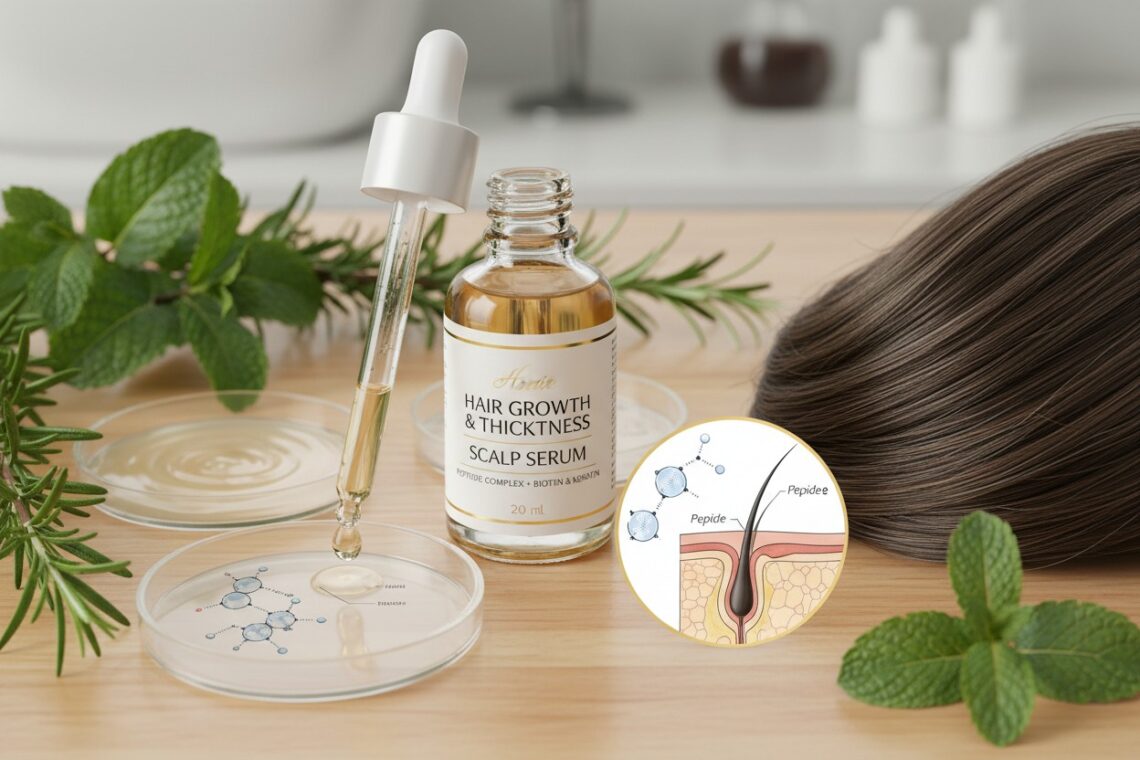
For the best results, choose a leave-on scalp serum if your goal is growth and density. Shampoos and rinse-off conditioners can support scalp health, but they do not stay on the skin long. A serum gives active ingredients more contact time. Apply it directly to the scalp, especially where your part is widening, your temples are thinning, or your crown looks sparse. Massage gently. More pressure is not better; aggressive rubbing can break fragile hairs.
The best peptide serums for thickness often include other supportive ingredients. Caffeine is commonly used for scalp vitality and the appearance of fuller hair. Niacinamide supports the skin barrier and may help irritated or oily scalps feel balanced. Panthenol adds moisture and softness. Hyaluronic acid hydrates the scalp without oiliness. Rosemary extract is popular, although it should not be treated as a guaranteed hair-loss cure. Green tea and zinc can be useful in scalp-balancing formulas.
If you are using minoxidil, peptides may still fit into your routine. Minoxidil is one of the best-known evidence-based topical treatments for pattern hair loss, while peptides are usually supportive cosmetic ingredients. Many people use minoxidil once or twice daily and add a peptide serum at a different time of day. Avoid layering too many wet products at once if it causes irritation or flakes. A dermatologist can help you build a routine if you are also using prescription treatments.
The timeline is important. Hair grows slowly. A peptide serum may make hair feel healthier within a few weeks, but density changes usually require patience. Give a scalp product at least 12 weeks before judging. For pattern hair loss, six months is a more realistic window. Take monthly photos from the same angle and lighting. Do not rely on memory, because hair changes are gradual.
Peptides are not the answer for every type of thinning. If you have sudden shedding, patchy bald spots, scalp pain, scaling, itching, or rapid loss, see a healthcare professional. You may need lab work, treatment for inflammation, evaluation for alopecia areata, thyroid testing, iron studies, or medication review. A peptide serum cannot fix a medical cause of hair loss by itself.
It is also worth separating topical peptides from injectable wellness peptides. Topical peptide serums are cosmetic products applied to the scalp. Injectable peptides promoted for anti-aging, weight loss, recovery, or hormones are a different category and may be unapproved or poorly studied for hair growth. Do not inject or ingest peptides for hair thickness without medical supervision.
The best peptides for hair growth and thickness are copper peptides, acetyl tetrapeptide-3, biotinoyl tripeptide-1, and keratin peptide complexes, depending on your goal. Choose copper peptides for scalp support, biomimetic peptides for density-focused serums, biotinoyl tripeptide-1 for stronger-looking growth, and keratin peptides for fragile strands. The best routine is consistent, scalp-focused, and realistic: treat the cause, support the follicle, protect the hair fiber, and measure progress over months rather than days.
For thickness, styling habits matter too. Peptides can support the look of fuller hair, but tight ponytails, heavy extensions, aggressive detangling, high heat, and frequent bleaching can make hair look thinner even while a serum is working. Use a wide-tooth comb, lower heat settings, and protective styling that does not pull at the hairline. If your hair is fine, avoid heavy oils on the scalp because they can collapse volume and make thinning look more obvious. A good peptide serum should disappear into the scalp, not leave the roots coated. Think of peptides as one layer in a thicker-hair system: scalp serum, gentle handling, protein when needed, and medical treatment if the follicle is miniaturizing.