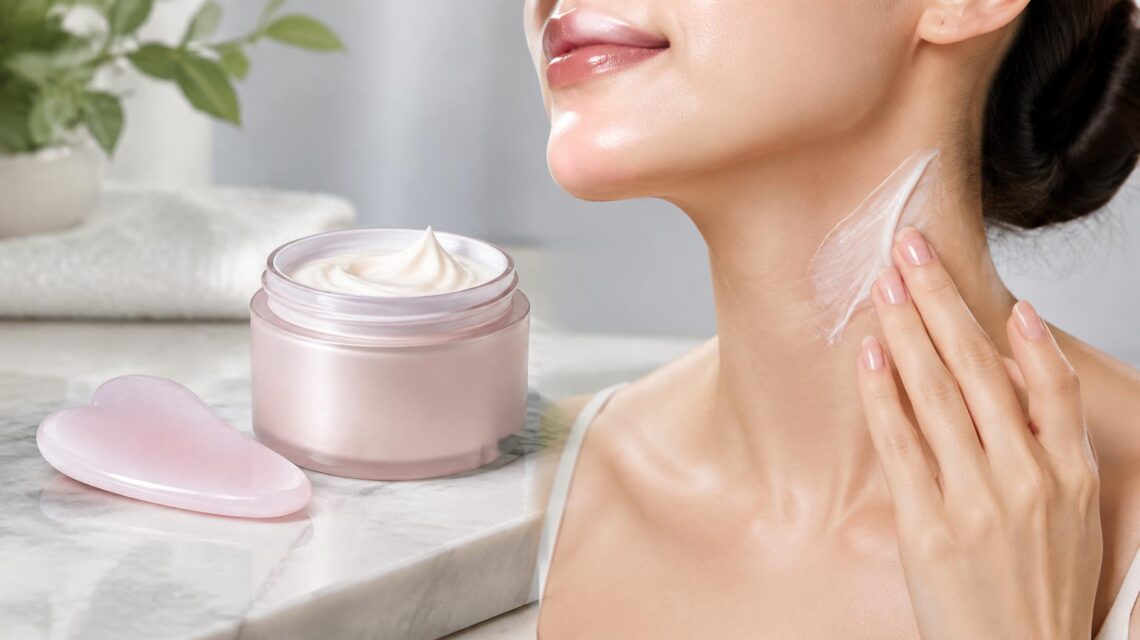
Medicube PDRN Collagen Gua Sha Neck Cream combines a neck and décolleté moisturizer with a built-in massage applicator. Its ingredient list includes Sodium DNA, hydrolyzed collagen, niacinamide, Volufiline, and acetyl hexapeptide-8. However, the most important distinction is easy to miss: PDRN is not a peptide, and these ingredients should not be treated as interchangeable.
Understanding that difference makes the product easier to evaluate without confusing cosmetic marketing with clinical evidence. Here is what the formula contains, what the gua sha applicator adds, and where claims about neck wrinkles need a closer look.
What Is Medicube PDRN Collagen Gua Sha Neck Cream?
The Medicube product page describes this product as a cream for the neck and décolleté with an integrated gua sha applicator. A retailer listing identifies the size as 90g.
The supplied brand listing gives a US price of USD32 and marks the product as sold out. Price and availability can change, so those details should be checked directly rather than treated as permanent.
The product combines two familiar skincare concepts: a moisturizing formula and a massage tool. That makes it different from a conventional cream jar, but the applicator does not automatically establish better ingredient penetration or stronger wrinkle-related results.
PDRN Is Not a Peptide: Why the Difference Matters
PDRN stands for polydeoxyribonucleotide. It refers to DNA-derived material made from nucleotide building blocks, not amino acids. In this product listing, the associated ingredient is Sodium DNA.
Peptides, by contrast, are chains of amino acids. That chemical distinction matters because ingredients with different structures cannot be assumed to have the same properties, evidence, or cosmetic role.
Sodium DNA and peptide ingredients belong to different categories
Describing PDRN as a peptide is inaccurate. A formula can contain both DNA-derived material and a peptide, but that does not make them the same ingredient type. In this cream, acetyl hexapeptide-8 is the specifically named peptide.
It is also important not to assume that every Sodium DNA ingredient is identical to every PDRN preparation discussed in research. Molecular characteristics, formulation, and delivery can differ. The product name alone cannot establish equivalence.
Topical skincare is not the same as an injectable treatment
Research involving an injectable preparation cannot automatically support claims for a topical neck cream. The route of delivery, concentration, finished formula, and study setting all matter.
The supplied sources do not establish a medical approval or therapeutic indication for this cream. It should therefore be evaluated as a cosmetic product, not presented as an approved treatment for tissue repair or a substitute for a medical procedure.
A Closer Look at the Main Ingredients
The most useful way to understand Medicube PDRN Collagen Gua Sha Neck Cream is to separate its ingredients by category rather than grouping them under a single anti-aging label.
Sodium DNA: the DNA-derived ingredient
Sodium DNA is the ingredient connected with the PDRN positioning. Its presence confirms that DNA-derived material is listed in the formula, but it does not independently demonstrate wrinkle reduction, skin regeneration, or structural lifting.
Those are outcome claims that require evidence for the finished product. An ingredient name is a starting point for evaluation, not proof of performance.
Hydrolyzed collagen: a processed protein ingredient
The collagen listed here is hydrolyzed collagen, a processed protein ingredient. It should not be confused with the separately listed acetyl hexapeptide-8 or described as though it were the same defined peptide active.
Collagen in a cosmetic formula also should not be equated with rebuilding the collagen network beneath the skin. Its inclusion may contribute to the formulation and skin-conditioning experience, but the ingredient name does not establish deeper structural replacement.
Acetyl hexapeptide-8: the named peptide
Acetyl hexapeptide-8 is a peptide ingredient. This is the clearest distinction to remember when reading the label: Sodium DNA is DNA-derived material, hydrolyzed collagen is a processed protein ingredient, and acetyl hexapeptide-8 is the named peptide.
Its presence does not make the cream equivalent to an injectable wrinkle treatment. Similar marketing language should never be mistaken for equivalent delivery, mechanism, or results.
Niacinamide and 5% Volufiline
Niacinamide also appears in the supplied ingredient information. It is a familiar cosmetic ingredient, but broad knowledge about niacinamide cannot establish the performance of this particular neck cream.
The brand lists 5% Volufiline. That is a formula detail, not an effectiveness percentage. It should not be interpreted as proof of increased tissue volume, permanent fullness, or a measurable lifting effect.
What Does the Built-In Gua Sha Applicator Add?
The integrated applicator is a defining feature of this product. It combines cream application and a gua sha-style massage step in one package, which may appeal to shoppers who prefer not to buy or store a separate tool.
However, convenience and clinical effectiveness are different questions. The supplied references do not establish that this applicator remodels the jawline, changes underlying anatomy, or produces lasting wrinkle correction.
- Format: The applicator is built into the cream packaging.
- Practical appeal: It combines product application with a massage-tool format.
- Evidence limit: Its presence does not prove deeper delivery or permanent lifting.
For anyone comparing this cream with a standard moisturizer, the applicator is best assessed as a packaging and application feature rather than treated as proof of superior results.
How to Read the Brand’s Clinical Claims
The supplied brand material includes agreement percentages and a jawline volume figure. However, the provided information does not identify the participant number, explain the measurement method, or link to a published paper.
That missing context limits what readers can conclude. A consumer agreement survey is not interchangeable with an independently assessed clinical measurement. Likewise, a volume figure is difficult to interpret without knowing what was measured, when it was measured, and whether a comparison group was used.
The figures should not be presented as proof that the cream lifts the jawline or reverses neck aging. More informative product evidence would describe:
- The number and characteristics of participants.
- The study duration and comparison conditions.
- The measurement equipment and assessment methods.
- Whether findings reflected user opinions or objective measurements.
- Any reported irritation, withdrawals, or other limitations.
Is This Neck Cream Worth Considering?
Medicube PDRN Collagen Gua Sha Neck Cream may interest shoppers who want a dedicated neck-and-décolleté product with a built-in applicator. Its ingredient combination and packaging provide concrete points of comparison with other cosmetic creams.
The more useful purchasing questions concern the complete ingredient list, texture preferences, packaging, price, and the quality of product-specific evidence. PDRN branding alone does not answer those questions, and an ingredient-focused product name cannot predict an individual experience.
The Bottom Line
PDRN is not a peptide. In this cream, Sodium DNA represents the DNA-derived ingredient, hydrolyzed collagen is a processed protein ingredient, and acetyl hexapeptide-8 is the named peptide. Keeping those categories separate prevents several common marketing misunderstandings.
The built-in gua sha applicator offers a distinctive application format, but the supplied evidence does not establish permanent lifting, structural rejuvenation, or equivalence to injectable procedures. The fairest assessment is to view this as a cosmetic neck cream with an integrated massage tool—and to judge its claims by the evidence available for the finished product.