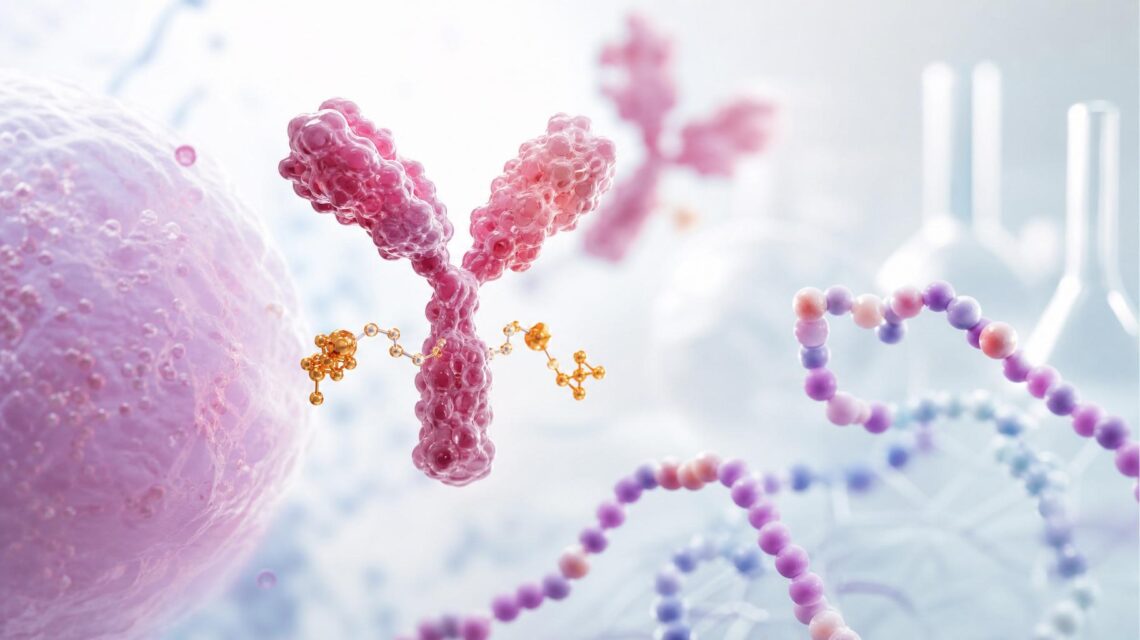
Trastuzumab emtansine, often known as T-DM1, is one of the most important antibody-drug conjugates in modern oncology. Its design combines the targeting power of a monoclonal antibody with the cell-killing ability of a potent cytotoxic payload. Because of this structural complexity, researchers place strong emphasis on detailed analytical characterization at both the intact protein level and the peptide level. Understanding this dual approach is essential for drug development, quality control, biosimilar assessment, and clinical confidence.
Characterizing trastuzumab emtansine is not as simple as measuring a single molecule. It involves studying a heterogeneous therapeutic made up of an antibody backbone, linker chemistry, and a drug payload attached in varying numbers. Each of these components can affect safety, stability, efficacy, and manufacturability. This is why advanced analytical strategies are used to reveal the complete molecular picture.
Why Trastuzumab Emtansine Requires Advanced Characterization
Trastuzumab emtansine is an antibody-drug conjugate, or ADC, developed to target HER2-positive cancer cells. The trastuzumab portion binds selectively to HER2 receptors, while the emtansine payload delivers cytotoxic activity after internalization. This targeted mechanism has transformed care in certain breast cancers, but it also introduces significant analytical challenges.
Unlike conventional monoclonal antibodies, ADCs such as trastuzumab emtansine are inherently more diverse. A single batch may contain molecules with different drug-to-antibody ratios, minor structural variants, and post-translational modifications. As a result, scientists need a multi-layered analytical framework to understand:
- Drug-to-antibody ratio distribution
- Site-specific conjugation patterns
- Primary amino acid sequence integrity
- Post-translational modifications
- Fragmentation or degradation products
- Batch-to-batch consistency
By combining intact-level and peptide-level characterization, analysts can evaluate both the overall molecular architecture and the highly detailed sequence-specific attributes that define product quality.
What Intact-Level Characterization Reveals
Intact-level characterization examines the full trastuzumab emtansine molecule with minimal digestion or breakdown. This top-level perspective is especially useful for understanding large-scale structural properties and molecular heterogeneity.
Assessing Molecular Mass and Heterogeneity
One of the first goals of intact analysis is to confirm the overall molecular mass of the ADC. Since trastuzumab emtansine consists of the antibody linked to one or more emtansine payloads, the total mass can vary depending on how many drug molecules are attached. Mass spectrometry is a key tool here, helping researchers identify the distribution of different ADC species present in the sample.
This makes it possible to evaluate the drug-to-antibody ratio, or DAR, which is one of the most important attributes of any ADC. A DAR that is too low may reduce therapeutic potency, while a DAR that is too high can impact stability, pharmacokinetics, and toxicity.
Monitoring Structural Integrity
Intact analysis also helps determine whether the antibody structure remains stable during production, formulation, and storage. Analysts can detect:
- Aggregation
- Unexpected fragmentation
- Partial loss of payload
- Large-scale modifications affecting molecular size
These findings are especially important in regulated biopharmaceutical manufacturing, where even small structural changes can influence product performance.
Understanding ADC Complexity
Because trastuzumab emtansine is not a single uniform chemical entity, intact-level methods provide a fast and effective way to capture the big-picture complexity of the product. Scientists can compare lots, identify major variants, and establish whether the expected conjugation profile has been achieved.
In many cases, intact mass analysis serves as the foundation for deeper characterization, signaling where more detailed peptide-level investigation is needed.
The Importance of Peptide-Level Characterization
While intact analysis provides a broad overview, peptide-level characterization delivers fine molecular detail. In this approach, the ADC is enzymatically digested into smaller peptides, which are then analyzed to confirm sequence identity and locate specific structural features.
Sequence Confirmation and Mapping
Peptide mapping is one of the most powerful tools for confirming that the trastuzumab backbone matches its intended amino acid sequence. This is essential for product identity testing and comparability studies. Even subtle sequence deviations can affect binding, stability, or immunogenicity.
At the peptide level, scientists can verify:
- Heavy chain and light chain sequences
- Expected cleavage products
- Disulfide-linked regions
- Specific conjugation sites
This detailed view is especially useful when investigating structural consistency after process changes or during biosimilar and follow-on product development.
Detection of Post-Translational Modifications
Therapeutic antibodies and ADCs often contain post-translational modifications such as oxidation, deamidation, glycosylation, and clipping. Some of these are expected and manageable, while others may signal instability or product stress.
Peptide-level analysis allows researchers to identify where these modifications occur and to what extent. This level of precision is critical because modifications in key functional regions may influence:
- HER2 binding activity
- Fc-mediated immune interactions
- Circulating half-life
- Overall product stability
Localization of Payload Attachment
Another major benefit of peptide analysis is the ability to pinpoint the exact sites of emtansine conjugation. Since the payload is typically linked through specific residues, understanding attachment location is essential for confirming manufacturing consistency and product design.
This site-specific information helps researchers understand whether conjugation is occurring as expected, whether off-target attachment has happened, and how the conjugation pattern may influence biological behavior.
Analytical Methods Commonly Used
Characterization of trastuzumab emtansine usually relies on a combination of orthogonal techniques. No single method can provide a complete picture, which is why complementary technologies are so important.
Mass Spectrometry
Mass spectrometry plays a central role in both intact and peptide-level analysis. At the intact level, it helps determine overall mass and DAR distribution. At the peptide level, it supports sequence mapping, modification analysis, and conjugation site identification.
Liquid Chromatography
Liquid chromatography is widely used to separate ADC components, peptide fragments, and charge variants before detection. When paired with mass spectrometry, it becomes an especially powerful platform for detailed molecular profiling.
Peptide Mapping Workflows
Enzymatic digestion followed by LC-MS analysis enables precise mapping of peptide fragments. This process can reveal sequence coverage, confirm domain integrity, and identify localized chemical changes that may not be visible in intact analysis alone.
Complementary Characterization Techniques
Additional tools may include:
- Capillary electrophoresis for charge heterogeneity
- Size-exclusion chromatography for aggregation analysis
- Glycan profiling methods for carbohydrate structure evaluation
- Reduced and subunit analysis for intermediate structural detail
Using multiple methods improves confidence in the final data set and helps avoid misinterpretation of highly complex ADC structures.
Why Intact and Peptide-Level Analysis Work Best Together
Neither intact nor peptide-level characterization alone is enough to fully define trastuzumab emtansine. Each approach answers different but equally important questions.
Intact-level analysis provides:
- A fast overview of molecular mass
- DAR distribution insights
- Whole-molecule heterogeneity assessment
- High-level stability monitoring
Peptide-level analysis provides:
- Sequence confirmation
- Localization of modifications
- Conjugation site mapping
- Detailed impurity investigation
Together, these methods create a complete analytical strategy that supports development from early research through final product release.