

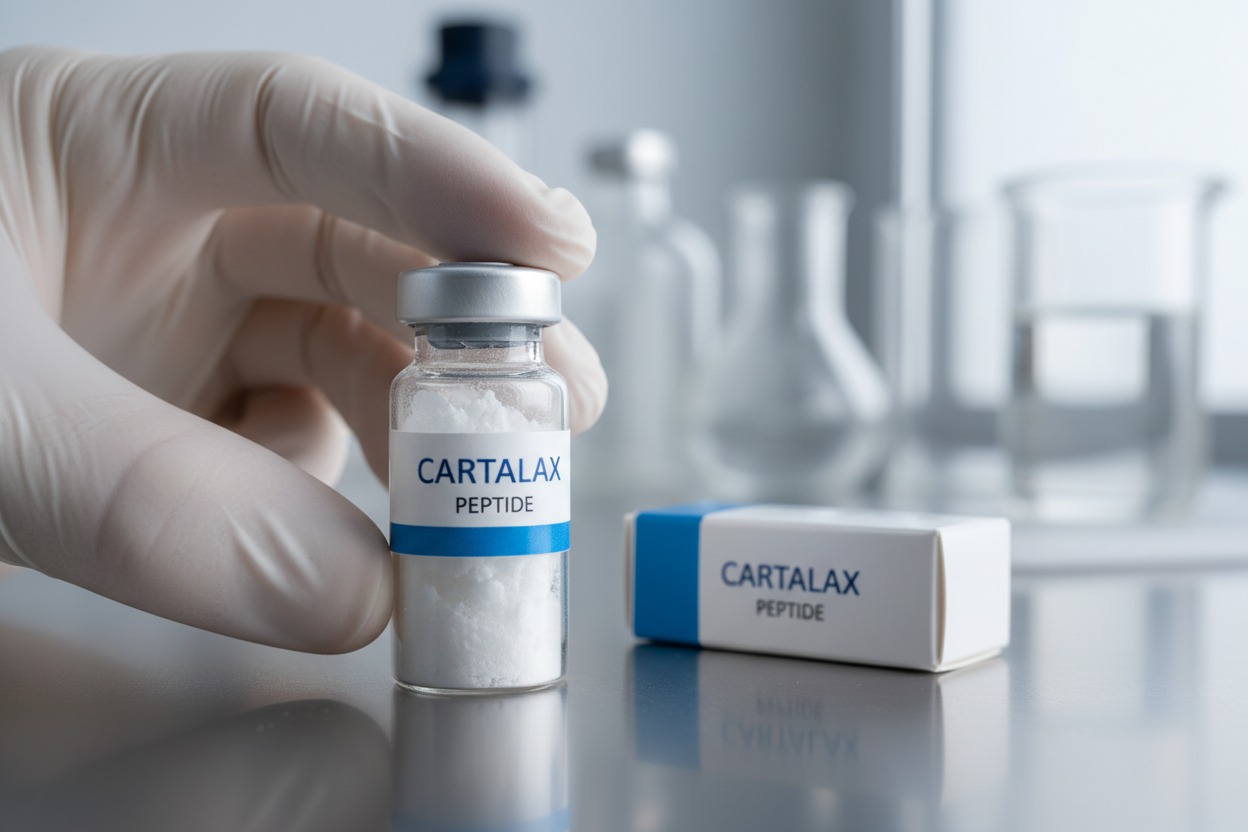
If you’ve been searching for Cartalax peptide, the first thing to know is that Cartalax is usually described as the AED tripeptide, also written as Ala-Glu-Asp. PubChem lists alanyl-glutamyl-aspartic acid with the synonym Cartalax, and a 2021 review of short peptides identifies AED (Cartalax) as a polyfunctional peptide linked in the literature to regulation of cartilage and skin fibroblast functions.
That sounds promising, but the evidence is not at the same level as mainstream FDA-reviewed joint therapies. The more careful way to frame Cartalax is this: it is a short bioregulatory peptide marketed for cartilage and musculoskeletal support, with mechanistic and preclinical interest, but only limited and less familiar human evidence in the public literature.
What is Cartalax peptide?
Cartalax peptide is generally described as a synthetic tripeptide made of alanine, glutamic acid, and aspartic acid. In peptide-bioregulator literature, it is associated with cartilage and bone tissue support, and some commercial sources also call it AED or AC-4. PubChem recognizes Cartalax as a synonym for alanyl-glutamyl-aspartic acid, which helps confirm that the peptide being discussed online is the same AED sequence.
A 2021 systematic review of peptide regulation of gene expression lists AED / Cartalax among “polyfunctional peptides” and summarizes it as linked to regulation of cartilage and skin fibroblast functions and neuronal cell differentiation. That is useful context, but it is still a broad literature summary, not proof of large-scale clinical benefit in people with arthritis or joint damage.
What is Cartalax marketed for?
Online, Cartalax is commonly marketed for:
- cartilage support
- joint comfort and mobility
- connective tissue support
- musculoskeletal aging support
- recovery-related joint health claims
You’ll also see it sold in more than one format. Some websites present Cartalax as a capsule-style bioregulator, while others sell it as a research-use peptide powder and explicitly say it is not intended for human or veterinary use and has not been evaluated by the FDA. That mixed marketplace is important, because it means people searching for “Cartalax peptide” may be looking at very different products under the same name.
What does the science say about Cartalax?
The best peer-reviewed support I found comes from the short-peptide / bioregulator literature rather than mainstream osteoarthritis treatment guidelines. A 2023 review on peptide regulation of chondrogenic stem cell differentiation says a cartilage polypeptide complex developed at the St. Petersburg Institute of Bioregulation and Gerontology includes the tripeptide AED, and that this complex is being investigated as a potential chondroprotector in pathology models including osteoarthritis. The same review says AED influenced gene expression involving NFκB, IGF1, and TNKS2, and affected proteins such as Ki67, CD98hc, caspase-3, and MMP9 in fibroblast aging models. The authors describe AED as chondro- and geroprotective in tone, but they still frame the field as one needing further development of effective and safe peptide-based stimulators of chondrogenesis.
That is the key distinction for SEO and credibility: Cartalax is discussed in research as biologically interesting, but it is still mostly presented as a prospective or emerging peptide, not an established standard treatment. Even the 2023 review’s conclusion is forward-looking, emphasizing that peptide-based chondrocyte differentiation stimulators are still part of an active development path rather than settled clinical practice.
Are there human studies on Cartalax?
There are some public descriptions of older clinical use, but they are not the kind of large, modern, internationally visible trials most readers expect. In a lecture PDF on musculoskeletal pathology, Cartalax was described as having been studied in patients aged 52 to 72 with knee osteoarthritis. That summary says Cartalax was used for 20 days alongside conventional treatment and that pain severity decreased in 55–63% of cases, while no significant radiologic change was seen over that short period.
That is interesting, but it should be interpreted cautiously. A lecture summary is not the same thing as a large randomized trial published in a top clinical journal, and the short treatment window plus lack of significant radiologic change makes it hard to treat this as definitive proof. The strongest honest framing is that small older reports exist, but the public evidence base still looks limited and not especially mature by modern standards.
Is Cartalax FDA approved?
What I found in the current U.S. online market is that Cartalax is often sold as a research compound with explicit statements that it is not intended for human use and has not been evaluated by the FDA. That does not prove every product labeled Cartalax is identical, but it does show that the peptide is not being presented in these channels as a standard FDA-reviewed therapy.
Because of that, the safest consumer-facing wording is: Cartalax does not appear to be a mainstream FDA-reviewed joint treatment in the form most people encounter online. In practice, that means people should be skeptical of any blog or seller that talks about it as though it were already a well-established, fully validated arthritis therapy.
Is Cartalax peptide safe?
The evidence I found does not support making strong safety claims. Some seller pages position Cartalax as research-only and not for human or veterinary use, which is already a sign that safety and quality should not be assumed from marketing language alone. Meanwhile, the peer-reviewed literature I found focuses much more on mechanisms and experimental promise than on robust long-term human safety data.
So the most credible answer is: safety is not well established in the way consumers usually mean it. There is enough research interest to justify curiosity, but not enough mainstream human data to justify treating Cartalax like a routine, proven joint-health solution.
Does Cartalax peptide work for joints?
It may have a real research story, but that is not the same as saying it is proven to work clinically. The scientific literature supports mechanistic plausibility and preclinical interest, especially around cartilage biology, chondrogenesis, and cell regulation. What it does not yet provide is the kind of broad, modern human evidence that would let you say with confidence that Cartalax works reliably for knee osteoarthritis, cartilage repair, or joint pain in general populations.
That makes Cartalax one of those peptides where the marketing usually outruns the evidence. The strongest version of the truth is that it is promising, niche, and still not clinically settled.
Final verdict
Cartalax peptide usually refers to the AED / Ala-Glu-Asp tripeptide associated with cartilage and musculoskeletal bioregulator literature. There is real scientific interest around its possible role in cartilage biology and joint-related aging pathways, and there are older reports suggesting symptom improvement in some osteoarthritis patients. But the evidence is still limited, the product is sold inconsistently across markets, and many online listings frame it as research use only rather than an established human therapy.
For a blog that wants to rank and stay trustworthy, the best angle is not hype. It is this: Cartalax is an emerging cartilage peptide with interesting early literature, but it is not yet a mainstream, fully validated joint treatment.
FAQ section
What is Cartalax peptide?
Cartalax peptide is generally described as the AED tripeptide with the sequence Ala-Glu-Asp and is marketed for cartilage and musculoskeletal support.
What is Cartalax used for?
It is commonly marketed for joint health, cartilage support, and connective tissue support, though these claims are stronger than the current mainstream human evidence base.
Is Cartalax FDA approved?
Many U.S.-facing online sellers label Cartalax as research use only and say it has not been evaluated by the FDA, which suggests it is not being sold as a standard FDA-reviewed therapy in those channels.
Is there human evidence for Cartalax?
There are older public reports of clinical use, including a lecture summary describing reduced pain in some knee osteoarthritis patients, but the evidence does not look like a large modern trial base.
Does Cartalax really repair cartilage?
Current literature supports research interest and possible biologic mechanisms, but it does not firmly establish Cartalax as a proven cartilage-repair treatment in routine human care.