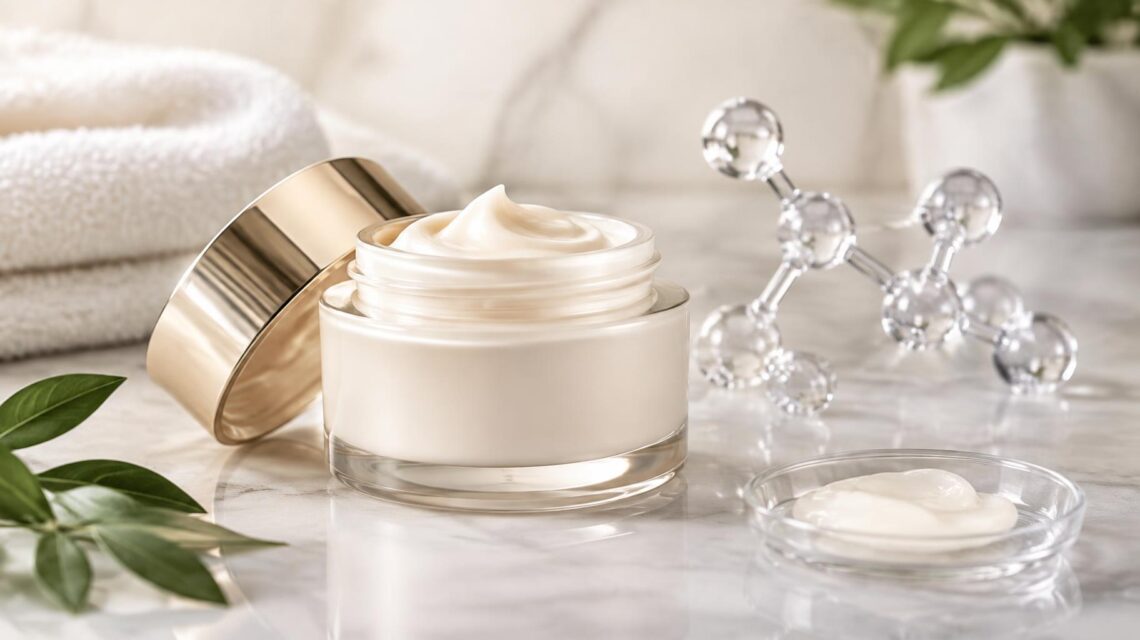
Peptides are everywhere in skincare, but a long ingredient list does not automatically make an eye cream worth the investment. Saint Jane Bright Revival Peptide Eye Cream makes its case with nine biosynthetic peptides, five forms of hyaluronic acid, and supporting ingredients including niacinamide and caffeine. At $65 for 15 ml, it sits firmly in the premium category.
The formula replaces Saint Jane Bright Repair Eye Cream, introducing a new name and a peptide-focused proposition. But what does its nine-peptide complex actually tell you, and how much weight should you give the advertised results? This ingredient-led review separates the formula facts from the marketing, without presenting a hands-on test or promising a particular outcome.
Saint Jane Bright Revival Peptide Eye Cream at a Glance
- Price and size: $65 for 15 ml.
- Product positioning: A premium eye cream focused on brighter-looking, firmer-looking skin.
- Peptide complex: Nine biosynthetic peptides listed in the INCI ingredient list.
- Supporting ingredients: Niacinamide, vitamin B12, caffeine, glycolic acid, and five forms of hyaluronic acid.
- Fragrance: Fragrance free.
- Reported testing: A consumer perception study involving 34 people, rather than a clinical trial.
- Previous product: Replaces Bright Repair Eye Cream.
These details establish what the product contains and how the brand positions it. They do not, by themselves, establish how well it will work for an individual or whether it outperforms a less expensive eye cream.
Inside the 9-Peptide Complex
The central feature of Saint Jane Bright Revival Peptide Eye Cream is its blend of nine biosynthetic peptides. Peptides are chains of amino acids, and different peptides can have different roles in cosmetic formulations. Treating all peptide ingredients as interchangeable can therefore be misleading.
Which Nine Peptides Are Listed?
The supplied ingredient information identifies the following INCI names:
- sh-Oligopeptide-1
- sh-Oligopeptide-2
- sh-Polypeptide-1
- sh-Polypeptide-3
- sh-Polypeptide-9
- sh-Polypeptide-11
- sh-Polypeptide-16
- sh-Polypeptide-22
- sh-Polypeptide-62
Those technical names help identify the ingredients, but they are not a performance scorecard. An INCI list does not reveal everything about ingredient concentration, stability, delivery, or the way the finished formula behaves on skin.
Does Having Nine Peptides Make It Better?
A higher peptide count is not proof of better results. Nine peptides make this formula distinctive, but the number alone cannot establish superiority over a cream containing fewer peptides—or none at all.
The more useful question is whether the complete product has convincing supporting evidence. Research involving an individual ingredient is not automatically evidence for every finished product containing it. Likewise, a sophisticated-sounding complex should not be interpreted as a guarantee of collagen production, wrinkle removal, or any medical effect.
The Supporting Ingredients Deserve Attention, Too
Although peptides lead the marketing, this is a multi-ingredient formula. Its other components help explain the product concept, particularly its emphasis on hydration and a refreshed-looking eye area.
Five Forms of Hyaluronic Acid
Hyaluronic acid is commonly used in cosmetics as a humectant, helping attract and retain moisture. Hydration can make dry skin look smoother and fine surface lines less noticeable, although that is different from permanently changing wrinkles.
Saint Jane lists five forms of hyaluronic acid. That variety is a formulation detail, not proof of five separate benefits or deeper delivery. The finished product, rather than the ingredient count, determines the overall experience.
Niacinamide and Vitamin B12
Niacinamide is a familiar skincare ingredient used in formulas concerned with moisture-barrier support and uneven-looking tone. Its presence fits the brightening positioning, but the supplied information does not establish its concentration or isolate its contribution to the reported results.
Vitamin B12 is also included. Its presence should not be interpreted as evidence that the cream treats a deficiency or produces a specific health benefit. Here, it is one component of a cosmetic formulation.
Caffeine and Glycolic Acid
Caffeine frequently appears in eye products marketed toward a more awake-looking appearance. That association does not establish that this particular cream will resolve puffiness or dark circles.
Glycolic acid is an exfoliating acid, although its behavior depends on factors including concentration and formula pH. Neither is established in the supplied material. It would therefore be inaccurate to describe Bright Revival as a strong exfoliating treatment simply because glycolic acid appears in its ingredient list.
What Do the Reported Results Actually Show?
Saint Jane reports that 92% of participants said the eye area looked brighter, while 89% said it looked firmer. Those figures come from a consumer perception study of 34 people, not a clinical trial.
That distinction matters. Consumer perception studies capture participants’ impressions of a product. Such feedback can be relevant to cosmetic appearance and satisfaction, but it is not equivalent to objective measurements or a controlled comparison.
The supplied information does not establish a placebo comparison, independently measured changes, or a published clinical evaluation. It also does not justify attaching either percentage to a particular timeline. The accurate takeaway is that most participants reported favorable impressions—not that the cream clinically proved a specific degree of brightening or firming.
Can It Help With Dark Circles and Fine Lines?
Brightening is a broad cosmetic term. A brighter-looking eye area may reflect better hydration or a change in the appearance of dullness; it does not necessarily mean a reduction in pigmentation.
Dark circles can also involve shadows, facial structure, visible vessels, or pigmentation. A topical cosmetic cannot be assumed to address all of those factors, and the supplied evidence does not establish that Bright Revival does.
Fine lines require similar nuance. Lines made more noticeable by dryness may look different when skin is moisturized. That is not the same as demonstrating a lasting change in deeper wrinkles. This eye cream is best assessed as a cosmetic product, not as a treatment for an underlying condition.
Fragrance Free: A Useful Detail, Not a Guarantee
Bright Revival Peptide Eye Cream is fragrance free, which may appeal to shoppers who prefer to avoid added fragrance in products used near the eyes.
However, fragrance free does not mean irritation free, allergy proof, or universally suitable. Individual tolerance varies, and the presence of multiple ingredients means the formula should be judged as a whole. The available information does not support describing it as safe for every sensitive-skin user.
Is Saint Jane Bright Revival Worth $65?
At $65 for 15 ml, the value depends on what you want from an eye cream. The formula may appeal to someone specifically seeking a fragrance-free product with a broad peptide blend and multiple familiar hydrating ingredients.
It is a less compelling purchase if your main requirement is strong clinical evidence for a particular concern. The consumer study offers useful context, but it does not establish superiority over a basic moisturizer or a competing eye cream.
- Reasons to consider it: Fragrance-free formulation, clearly identified peptide ingredients, and a hydration-focused supporting blend.
- Reasons to be cautious: Premium price, limited supplied testing details, and no established head-to-head advantage.
Final Verdict
Saint Jane Bright Revival Peptide Eye Cream has an interesting formula, but its strongest selling point—the nine-peptide complex—should not overshadow the limits of the evidence. Its supporting ingredients make the hydration and refreshed-appearance positioning understandable, while the fragrance-free format is a practical attraction.
Consider it a premium cosmetic option with encouraging consumer feedback, not a clinically proven solution for dark circles or wrinkles. Whether it earns a place in your routine depends on your budget, preferences, and expectations—not simply how many peptides appear on the label.
Sources: Saint Jane Beauty product information and Credo Beauty product listing.