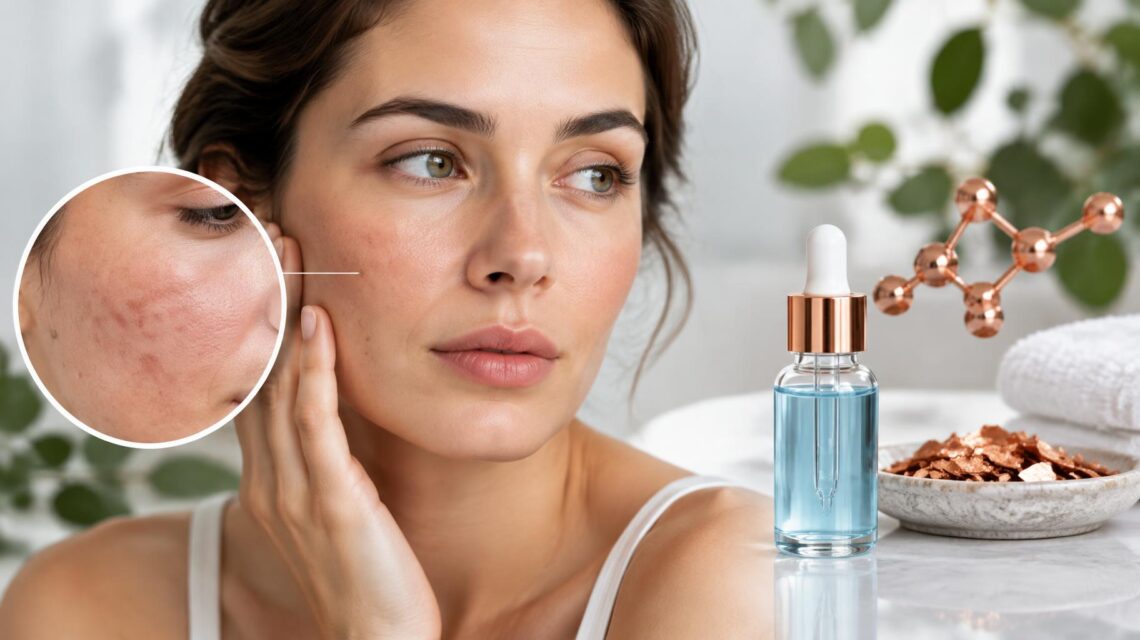
If you have searched for copper peptides ruined my skin, you may be dealing with redness, bumps, dryness, or a complexion that suddenly looks worse after introducing a new serum. That experience can be frustrating, especially when the product was marketed as a gentle addition to your skincare routine.
However, a reaction after using a copper peptide product does not automatically mean the ingredient caused permanent damage. The complete formula, other products in your routine, and an unrelated skin condition may all be relevant. Understanding those possibilities is more useful than assuming that every reaction has the same cause.
This article explores why a copper peptide serum might appear to upset your skin, what recovery generally involves, and why some symptoms deserve professional assessment. It is educational information, not a diagnosis or an individual treatment plan.
Understanding a Skin Reaction After Copper Peptides
Copper peptides are copper-associated peptide ingredients used in some cosmetic skincare formulas. They are often discussed in connection with skin appearance and anti-aging routines. However, marketing claims, laboratory research, and evidence about a finished cosmetic product are not interchangeable.
A topical cosmetic serum is also different from an injectable or experimental research compound. A research product should not be assumed to be approved, suitable for cosmetic use, or established as safe for self-treatment. Its regulatory status depends on the particular product and intended use.
Without product-specific evidence, it is not possible to promise benefits or determine exactly why a reaction occurred. Even a serum containing a familiar ingredient may include preservatives, fragrances, solvents, and other components that affect how an individual tolerates it.
Why Copper Peptides Might Seem to Ruin Your Skin
The Finished Formula May Be the Problem
It is easy to blame the ingredient highlighted on the packaging. Yet a copper peptide serum contains more than copper peptides. A reaction might relate to another ingredient, the overall formulation, or how the product interacts with your existing routine.
For example, fragrance can be a concern for some sensitive individuals, while a rich formula may feel unsuitable for certain skin types. These possibilities do not prove which component caused the problem. They explain why the label alone cannot establish the cause.
An Already Irritated Routine Can Complicate the Picture
A new serum may enter a routine that already includes exfoliating acids, retinoids, scrubs, or several other active products. If the skin is already uncomfortable, the latest addition may receive all the blame even when the situation is more complicated.
Timing is a clue, not proof. Symptoms that begin after a new product deserve attention, but they do not establish that copper peptides specifically caused them. Introducing several products together makes it particularly difficult to identify a trigger.
Irritation and Allergy Are Different Possibilities
Burning, stinging, redness, itching, and rash-like changes can occur in different types of skin reactions. Irritation and allergic contact dermatitis are not the same condition, although their appearance can overlap.
A dermatologist may use the history, examination, and sometimes testing to investigate the difference. Describing every reaction as an allergy, or dismissing every rash as ordinary irritation, can obscure what is happening.
An Unrelated Skin Issue May Coincide With Use
Breakouts and changes in texture can also coincide with a new product without being caused by it. Weather, changes elsewhere in the routine, and existing skin conditions may influence the picture. A before-and-after photo documents a change, but does not explain its cause.
Is It Purging, Irritation, or a Breakout?
The term purging is often used online to explain almost any worsening after a skincare purchase. That can encourage people to tolerate symptoms under the assumption that improvement must eventually follow.
A breakout after starting a copper peptide product should not automatically be called purging. Without supporting evidence about the product and the symptoms, that explanation remains uncertain. Persistent burning, swelling, itching, or rash-like changes are not reliable signs that a product is working.
- Stinging or burning: These describe discomfort, not evidence of effectiveness.
- Itching or rash-like patches: These can have several causes and may require assessment.
- New bumps: These do not, by themselves, distinguish acne from another reaction.
- Dryness or peeling: These may reflect irritation or another skin issue rather than a desired adjustment.
Online descriptions cannot reliably diagnose these patterns. Similar-looking symptoms can require different explanations.
What Skin Recovery Generally Involves
Identifying the Trigger Comes First
Recovery is not necessarily about finding another active ingredient to reverse the reaction. In general, evaluating a suspected cosmetic reaction involves identifying possible triggers and avoiding further unnecessary exposure while the cause is assessed.
Continuing a product despite worsening symptoms is not a dependable way to establish tolerance. Likewise, repeatedly trying it again can make the pattern harder to interpret and may reproduce the reaction.
A Simpler Routine Makes Changes Easier to Track
Discussions of irritated-skin care commonly emphasize simplicity rather than adding more treatments. A routine with fewer variables can make it easier to understand which products are comfortable and which may be associated with symptoms.
Gentle cleansing, moisturizing, and sun protection are common elements of basic skincare. However, no category guarantees tolerance: even products labeled gentle, natural, or suitable for sensitive skin can disagree with an individual. Product selection during an active reaction is best discussed with a qualified clinician.
Adding More Actives Can Create Confusion
Trying to correct redness or uneven texture with extra exfoliation, strong treatments, or several new serums can introduce additional variables. It may become impossible to tell whether the original reaction is continuing or a different product is contributing.
There is no universal copper peptide recovery protocol. The appropriate approach depends on what the symptoms actually represent, rather than the ingredient name alone.
How Long Does Recovery Take?
There is no reliable recovery timeline that applies to everyone. The nature of the reaction, continued exposure, the products involved, and any underlying condition can all affect its course.
Claims that skin always returns to normal within a fixed number of days are misleading. Similarly, a temporary change in appearance does not establish permanent damage. Persistent symptoms require evaluation rather than increasingly confident guesses based on online anecdotes.
When Symptoms Deserve Medical Attention
Severe pain, substantial swelling, blistering, rapidly spreading redness, eye involvement, or signs of infection warrant prompt medical assessment. Breathing difficulty or swelling affecting the lips, tongue, or throat can be an emergency.
Professional assessment is also valuable when symptoms persist, recur, or leave their cause unclear. A clinician can help distinguish a cosmetic reaction from a condition that happened to appear at the same time.
Useful Information to Record
A clear product history can make a discussion with a dermatologist more productive. Relevant details include:
- The exact product name and full ingredient list.
- When use began and when symptoms first appeared.
- Other products introduced or changed around that time.
- Where the symptoms appeared and how they felt.
- Photographs showing changes under similar lighting.
Home testing cannot guarantee that a product will be safe on the face, and it is not equivalent to clinician-directed allergy testing.
The Bottom Line
If copper peptides seem to have ruined your skin, the experience deserves attention without jumping to conclusions about permanent damage. The peptide, another formula ingredient, an overloaded routine, or an unrelated condition may be involved.
The most useful focus is understanding the reaction, limiting unnecessary product experimentation, and obtaining appropriate assessment when symptoms are significant or persistent. Marketing promises and online recovery stories cannot replace an explanation grounded in your actual symptoms.