CBL-514 is an experimental injection that kills fat cells in the specific spot where it is injected. It is not approved anywhere in the world, and it is not a peptide — two facts that most of what you will read about it right now gets wrong.
US search interest in the compound jumped roughly 2,950% in the past week. That spike is not driven by an approval or a leak. It is driven by the compound’s developer, Taiwan-based Caliway Biopharmaceuticals, clearing the US FDA to begin a second global pivotal Phase 3 trial, which put CBL-514 into the same news cycle as the retatrutide Phase 3 data. People searching for one are now finding the other.
Here is what the evidence actually supports.
CBL-514 is not a peptide
Caliway describes CBL-514 as a first-in-class small-molecule drug. Peptides are short chains of amino acids — BPC-157, GHK-Cu, sermorelin and retatrutide all are. CBL-514 is not built that way, so none of the peptide rules of thumb transfer to it.
That distinction matters practically, not just pedantically:
- It is not sold as a research peptide. Peptide vendors stock compounds that are cheap to synthesise as amino acid chains. CBL-514 is a patented small molecule held by a single company running registrational trials. There is no legitimate grey-market supply.
- Peptide dosing logic does not apply. Reconstitution calculators, mg/mcg conversions and the usual peptide handling conventions are irrelevant to a compound nobody outside a trial site should be handling.
- Its safety record is its own. CBL-514’s trial data says nothing about any peptide, and no peptide’s track record says anything about CBL-514.
It gets grouped with peptides anyway because it arrives through the same channels — body-recomposition forums, longevity newsletters, aesthetic clinics — and because “injectable fat loss” is the category people search, not “small molecule.”
How it works: apoptosis, not demolition
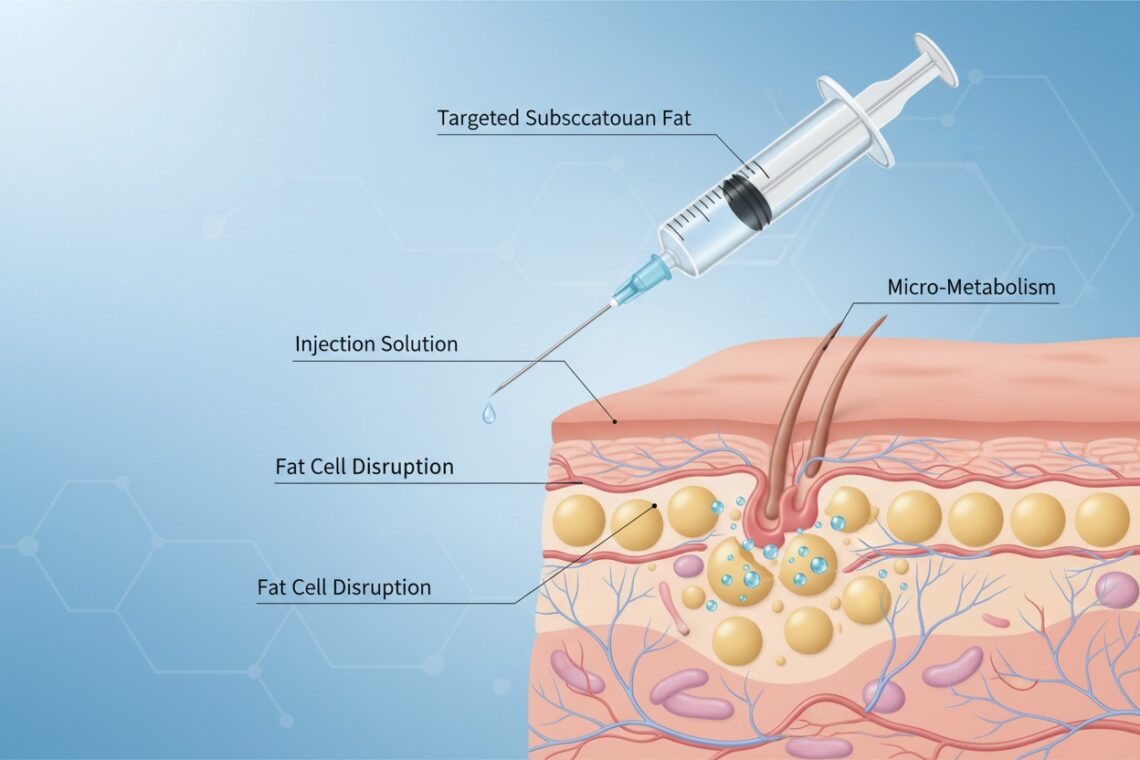
CBL-514 induces apoptosis in fat cells — programmed cell death, the orderly process a cell uses to dismantle itself. Caliway reports the effect is selective for adipocytes and stays local, without systemic effects on the nervous, cardiovascular or respiratory systems.
That is a different mechanism from the two things people compare it to.
| CBL-514 | Kybella (deoxycholic acid) | GLP-1 drugs (semaglutide, retatrutide) | |
|---|---|---|---|
| How it removes fat | Triggers apoptosis in fat cells | Dissolves fat cell membranes | Reduces appetite and alters metabolism |
| Where it acts | Only the injected area | Only the injected area | Whole body |
| Approved? | No — Phase 3 | Yes, US, submental fat | Yes (semaglutide); retatrutide in Phase 3 |
| Typical reaction | Mild to moderate injection site reactions | Marked swelling, bruising, numbness | Nausea, GI effects, muscle loss concerns |
The contrast with Kybella is the interesting one. Deoxycholic acid is a detergent: it ruptures cell membranes, spilling the contents and provoking a strong inflammatory clean-up, which is why Kybella swelling is famously severe. Apoptosis is the tidier route — the cell packages itself for removal — and in theory produces less inflammation for the same fat loss. The Phase 2b safety data is consistent with that theory, though no head-to-head trial against Kybella exists.
The contrast with GLP-1s is simpler: CBL-514 is not a weight-loss drug. It does not touch appetite or body weight. It reduces fat in one treated area, which makes it a body-contouring drug that competes with liposuction and cryolipolysis, not with Ozempic.
What the trial data actually shows
The strongest published evidence is CBL-0205, a randomised, placebo-controlled Phase 2b study in 173 participants with moderate to severe abdominal fat. Participants received up to four subcutaneous treatments, one every three weeks, with results measured four weeks after the final treatment.
| Outcome | CBL-514 | Placebo |
|---|---|---|
| Mean abdominal fat volume change | −22.4% | +1.8% |
| Participants achieving ≥20% fat reduction | 54.2% | 0% |
| ≥1-grade improvement on clinician fat rating scale | ~80% | — |
The difference versus placebo was significant at p<0.00001. A separate Phase 2b study, CBL-0204, also met all primary and secondary efficacy endpoints, and the abdominal Phase 2b work has since been published in the Aesthetic Surgery Journal with MRI, clinician-reported and patient-reported outcomes.
On safety, Caliway reports no drug-related serious adverse events and no systemic side effects, with the most common events being mild to moderate injection site reactions. Across 10 completed trials covering 544 subjects, the company says the compound met all efficacy and safety endpoints.
Two honest caveats. Most of these figures come from company announcements rather than independent analysis, which is normal at this stage but is not the same as peer-reviewed scrutiny of every number. And a 22.4% reduction is a reduction in the fat volume of the treated area — not 22.4% of body fat, and not a change in body weight.
Where it is right now
CBL-514 is in registrational Phase 3 testing on two separate tracks.
Body contouring. SUPREME-01 is the first global pivotal trial: 300 participants randomised 1:1 across 29 sites in the US and Canada, with recruitment opening in Q3 2025. It measures two co-primary endpoints — abdominal fat volume change on MRI, and patient-reported improvement on a validated fat rating scale. Topline results are expected between Q4 2026 and Q1 2027. SUPREME-02 followed, and the FDA cleared a third pivotal study, CBL-0302, on 18 May 2026 — roughly 320 participants across the US, Canada and Australia, with topline data anticipated in 2027. That clearance is what pushed the compound into the news this month.
Dercum’s disease. A separate and more advanced-sounding track. Dercum’s is a rare condition causing painful lipomas on the trunk and upper limbs, with no approved treatment. CBL-514 holds FDA Fast Track and Orphan Drug designations plus an EMA orphan designation granted in November 2024 — the first drug to hold that combination for the condition. In a completed Phase 2 study, 64.5% of painful lipomas shrank by more than half, 38.7% cleared completely, and pain fell by 4.7 points.
A realistic read: even if the Phase 3 trials succeed, data lands in 2027, and filing and review add time after that. Nobody is getting this at a clinic in 2026.
Can you buy it? No
CBL-514 is not approved by any regulator, anywhere. It is available in exactly one place: an enrolled site in one of Caliway’s trials.
That makes any vendor listing “CBL-514” a straightforward red flag. The compound is a patented small molecule in active registrational trials, held by one company that has every commercial reason not to let supply leak. A research-chemical site offering it is selling something that is at best not CBL-514, and there is no way for a buyer to tell which.
This is worth stating plainly because the same search spike that brought you here brings sellers too. The pattern is familiar from retatrutide, where counterfeit product circulated widely while the real compound was still in trials. Expect the same here, earlier in the curve.
What to watch, and what is still unknown
The Phase 2b results are genuinely strong for an aesthetic injectable, and the mechanism is more elegant than what is on the market. But several things that matter to anyone considering it eventually are simply not yet answered:
- Durability. Apoptosis removes fat cells rather than shrinking them, which should make results lasting. How lasting, across years and weight fluctuation, has not been published.
- Repeat treatment. The protocol is up to four sessions three weeks apart. Whether results improve with further courses, and whether safety holds, is untested.
- Cost. Unknowable until approval, but a four-session course of a branded injectable is unlikely to undercut liposuction by much.
- Who it suits. Trial participants had moderate to severe localised abdominal fat. This is a contouring treatment for a discrete area, not an obesity treatment, and the trials were not designed to answer whether it helps anyone outside that profile.
The realistic milestone to watch is SUPREME-01 topline data, expected between Q4 2026 and Q1 2027. That is the first independent-scale test of whether the Phase 2b effect holds in a registrational trial.
This article is informational and describes research in progress. CBL-514 is an investigational drug that is not approved for use. Nothing here is medical advice — talk to a qualified clinician about your own situation.
Sources
| Source | What it covers |
|---|---|
| Caliway: CBL-0205 Phase 2b results | 173-participant Phase 2b efficacy and safety data |
| Caliway: SUPREME-01 Phase 3 IND clearance | Mechanism, drug class, Phase 3 design and timeline |
| PR Newswire: CBL-0302 IND clearance | Third pivotal Phase 3 study, cleared May 2026 |
| BioSpace: EMA orphan designation, Dercum’s disease | Orphan and Fast Track status, Phase 2 lipoma data |
| Aesthetic Surgery Journal: Phase 2b trial | Peer-reviewed abdominal fat reduction trial |